NEW YORK (CNNMoney.com) -- Call the last 10 years whatever you want: the Naughty Aughties, the Awful Aughts or the Zilches are all appropriate. If you are an investor, you're probably thankful the decade is over and are longing for better times ahead in the Teens.
The Dow is 8% lower than where it started this decade and it's been much worse for the broader market. The S&P 500 is off 23% and the Nasdaq, still smarting from the tech bubble's bursting way back in 2000, has dropped 44%.
It was a brutal ten years for market bulls. But some blue chips, such as Nike, Caterpillar and FedEx, fought off the bears.
It would be one thing if this decade was merely one of sluggish economic growth and poor stock performance. But in addition to two recessions, including the worst since the Great Depression, the 2000s were a period marked by scandals, poor business decisions and greed run amok.
It's fair to wonder why anyone should trust Wall Street and Corporate America ever again.
This decade gave us the accounting frauds at Enron, WorldCom, Adelphia and Tyco. There were several textbook cases of mergers gone bad. Sprint-Nextel, Alcatel-Lucent, and of course my parent company's Time Warner-AOL fiasco instantly pop to mind.
To top all that off, the decade came to a close with the multibillion dollar taxpayer bailout of the nation's banking system and the government-backed bankruptcies of two of Detroit's Big Three automakers.
But as tempting as it may be to declare that the financial markets are broken, that the U.S. economy has peaked and that the notion of buying and holding stocks for the long-term has gone the way of the dodo, that would be misguided.
For all that went wrong since the clock struck midnight in Y2K, there was also a fair amount of news to celebrate in the world of business. Innovation and sound business practices haven't completely died.
We witnessed the triumphant resurgence of Apple (AAPL, Fortune 500). New leadership leading turnarounds at American icons Walt Disney (DIS, Fortune 500) and Coca-Cola (KO, Fortune 500). The rise to market dominance by Google (GOOG, Fortune 500) and Amazon.com (AMZN, Fortune 500). The continued growth of Wal-Mart (WMT, Fortune 500) and Starbucks (SBUX, Fortune 500) around the globe.
Although the stock market as a whole performed miserably, there were gems for investors that worked hard to find them. Blue chip S&P 500 companies such as Nike (NKE, Fortune 500), FedEx (FDX, Fortune 500) and Caterpillar (CAT, Fortune 500) have all more than doubled in the past decade.
0:00 /1:53The decade of market discontent
And if you were fortunate enough to have $56,000 lying around at the end of 1999 and bought a share of Warren Buffett's Berkshire Hathaway (BRKA, Fortune 500), you'd now be sitting on a 76% return.
There is hope for less-affluent fans of the Oracle of Omaha though. The company's B stock (BRKB) is set to split in 2010, which means average investors will be able to buy a share for about $65 based on current prices.
There's even value to be had from investing in actively-managed mutual funds, which have been declared obsolete numerous times this decade as exchange-traded funds have exploded in popularity.
According to figures from fund tracker Morningstar, Ken Heebner's CGM Focus fund enjoyed annualized returns of more than 18% over the past 10 years while funds run by investing gurus Don Yacktman, Chuck Royce and David Ellison posted average annual returns in the double digits.
This all goes to show that it's probably best to not dwell for too long on all that went wrong in the Aughts. Capitalism isn't dead. Not every corporate CEO is a sociopath. Investing in stocks is still a good way to accumulate wealth over the long haul.
Let's try and learn from the mistakes and hope that the next 10 years are better. And to all readers of the Buzz, I'd like to wish you a happy and safe New Year's Day and a healthy and prosperous 2010. Thanks for all of your e-mails and Talkback comments this year and I look forward to interacting even more with you in the coming months. To top of page
Thursday, December 31, 2009

Wednesday, December 30, 2009
Commerical Real Estate now?
Breakthrough Technology Killing Cancer with a 96% Success Rate
December 30, 2009 | Issue #1166
Dear Investment U Reader,
David Fessler continues to relentlessly cover the faltering commercial real estate sector. Bottom line, its health is integral to any meaningful economic recovery.
That being said, I was surprised when Dave expressed his latest view of the situation during a phone conversation yesterday. See if you are, too.
And please, don't be shy about posting a comment for Dave.
Ahead of the tape,
Robert Williams, Publisher, Investment U
The Company Set to Dominate a $60 Billion-a-Year Market
$60 billion is spent on cancer treatment in the U.S. - each year. And one company is poised to receive the lion's share of it.
The medical director at the Alta Bates Comprehensive Cancer Center says, "...possibly a third of our cancer patient population will soon be undergoing this [company's] treatment." Another doctor at the University of Texas MD Anderson Cancer Center says he intends to treat over 1,000 patients a year with this technology.
Here's how you can claim your stake in the company before this cash infusion sends shares soaring.
Why Now Is the Perfect Time to Invest in Commercial Real Estate
[Dave Fessler]
David Fessler
Energy and Infrastructure Specialist
Back in April, I wrote a column detailing the looming train wreck in the commercial real estate market.
It turned out to be a rather controversial piece.
How controversial? You can judge for yourself here. And it was groundbreaking enough to land me a spot on Glenn Beck's show on Fox News.
Virtually nobody else was talking about the topic and a number of readers e-mailed to tell me how daft I was for even mentioning it. But I sensed the mess coming a mile away.
Investment Resources
Market Wake-Up Call:
Reach Your Financial Goals in Less than Twenty Minutes a Year
Alexander Green, Interview
Related Articles:
The Commercial Real Estate Sector: As the Other Shoe Drops - Be Wary of Bank Stocks
The Commercial Real Estate Fallout: Profiting From the Death of the Shopping Mall
How to Invest in the Booming Real Estate Market...
Right now, commercial real estate is in the gutter. It's where the banks were last March. No one wants to touch the sector in any form.
But I think it's time to jump back in.
And before you think I've sucked down a little too much holiday eggnog, hear me out...
A Contrarian Bet Worth $9.5 Billion
I'm in good company with my projection here.
During last February and March, a hedge fund called Appaloosa Management was busy buying up shares of Bank of America (NYSE: BAC) and Citigroup (NYSE: C).
And the guy calling the shots was a man named David Tepper, who runs the fund.
At the time, investors, colleagues and even his friends thought he was nuts - a move akin to lounging on the deck of the Titanic while everyone else abandons ship.
But in yet another example of how it's often wise to take a contrarian investment stance, the bet not only paid off handsomely for Tepper's firm, but for Tepper personally. Appaloosa is up nearly $7 billion on the trade, while Tepper stands to pocket a very cool $2.5 billion in profit for himself.
Tepper's no one-hit wonder either...
His track record includes huge payouts for his investors in Korean stocks, Russian debt, junk bonds and commodities over the last decade.
We should all be so astute...
Perhaps we can be, because there's still time to get in on his next big idea...
A Lonely Voice in a Sea of Pessimism
Tepper is quietly purchasing commercial mortgage-backed securities (CMBS).
His purchases include large chunks of real-estate debt - mostly in the form of bonds, according to the Wall Street Journal.
Most notable among them are huge portions of the debt of two New York City developments - Peter Cooper Village and 666 Fifth Avenue, both high-profile real estate development deals. Tepper believes both are significantly undervalued.
Once again, many of his peers disagree, noting that the current tepid market for commercial properties - and their associated debt refinancing problems - portents nothing but more gloom and doom for the sector.
Take Sam Zell, for example. Speaking at an exclusive investment conference in Chicago, he said: "Everybody is waiting for the Grave Dancer to come in, but at this point property owners won't tango."
Zell feels it's still too early, as commercial property owners and their lenders have deluded themselves into believing prices will recover and vacancies will begin to drop. He feels we still have another 30% drop ahead before any prices start to firm.
So who's right?
Where's the Tipping Point for Commercial Real Estate?
Take a trip to your local mall, and your first instinct could be to side with Zell. By simply counting empty stores, even rookie investors would get the sense that the retail side of commercial real estate is still in big trouble.
But other commercial properties aren't faring any better, as many office and small warehousing facilities sit vacant.
So if Zell and others believe things will get worse, how can we identify the real bottom in commercial real estate? Unfortunately, nobody can pinpoint it with 100% accuracy.
But we can take a look at history and come up with a very good guess. And the results may surprise you...
The Three Stages of All Economic Downturns
If you haven't read Ken Rogoff's book, called This Time is Different: Eight Centuries of Financial Folly, do yourself a favor and check it out. It's a definitive work, describing how the long history of financial cycles fits in with the current banking crash.
According to Rogoff, "the worm is turning" and if what he believes is history repeating itself for the ninth time, perhaps Tepper's timing is perfect.
In his book, Rogoff talks about the "Crisis Effect," which says you can separate all economic downturns into three components: housing, equities and unemployment.
He notes that housing can take five to six years to return to pre-downturn levels, equities can take two to three years, and unemployment can take four to five years. From peak levels, housing can fall about 30% and equities by as much as 50%.
Employment, however, can actually rise by 5-10% by the time the downturn ends.
But, it's the order in which these events happen that's important, particularly when making the case for a rebound in commercial real estate.
According to Rogoff's research, equities rebound first, then unemployment and finally real estate. Let's take a look at each one...
Why Tepper's Timing Could Be Perfect Again
* Stocks: The common consensus among most economists and Wall Street analysts is that equities put in a firm bottom back in March 2009.
* Unemployment: Recent data and the forecast for 2010 are both positive. According to CareerBuilder.com's 2010 job forecast, 20% of all employers plan to add full-time positions in 2010 - a rise of nearly 43% from 2009 levels.
* Real Estate: The housing market collapse started back in June 2006, right around the time home prices peaked, according to the Case-Shiller Home Price Index.
As you can see, that leaves us just over three-and-a-half years into the real estate correction, making it seem like David Tepper is nearly two years too early.
But if you believe - like I do - that this correction is really a severe over-correction (at least in terms of price) and that prices are likely to head up from here, then Tepper's timing is perfect.
You see, there's no construction happening in commercial real estate at the moment. None. This will cause vacancy rates to slowly drop and steadily increasing demand will fill a lot of the current empty space.
As the Wall Street Journal recently quoted Tepper: "If you think the economy will be fine, as we do, then we're going to do very well."
So how can you take advantage of this when it comes to commercial real estate?
Three Stocks to Capture the Real Estate Rebound
The best (and easiest) way to invest is through ETFs that specialize in commercial real estate holdings. Here are three commercial REIT plays to consider for long plays:
* iShares FTSE Industrial/Office Index (NYSE: FIO) - up 29% in 2009.
* Vanguard REIT Index (NYSE: VNQ) - up 27% in 2009.
* SPDR Dow Jones REIT (NYSE:RWR ) - up 26% in 2009.
You could also consider ProShares Ultra Real Estate (NYSE: URE), which aims to pocket gains that are twice that of the Dow Jones U.S. Real Estate Index.
Good investing,
Dave Fessler
Editor's Note: It's that time of year again. Time for millions of people across the world to make bold New Year's resolutions. Hit the gym and lose weight/get fit. Stop drinking, etc.
Many of them usually don't end up lasting very long. But here's one that will: Resolve to become wealthier in 2010 - and allow The Oxford Club to help you reach your goal.
While many folks are busy getting their end-of-year financial affairs in order, gobbling up retail discounts with their Christmas money, or preparing for a rowdy New Year's Eve, why not set aside a mere $79 that could be the most profitable investment you'll make for the next 12 months? Just go here to see exactly what we mean.
Click here to leave your comments on this article.
Not a Stock. Not a Bond. A Better Way to Invest.
Recently, Investment U and EverBank combined resources to create a unique "one-stop" investment vehicle that protects your future wealth. It's not a stock... nor a bond... but a combination of two sizzling hot investment vehicles - currencies and precious metals - into one single portfolio. It's a way to diversify your money and risk... with the potential for capital growth over time... through one single vehicle. Click here for full details.
December 30, 2009 | Issue #1166
Dear Investment U Reader,
David Fessler continues to relentlessly cover the faltering commercial real estate sector. Bottom line, its health is integral to any meaningful economic recovery.
That being said, I was surprised when Dave expressed his latest view of the situation during a phone conversation yesterday. See if you are, too.
And please, don't be shy about posting a comment for Dave.
Ahead of the tape,
Robert Williams, Publisher, Investment U
The Company Set to Dominate a $60 Billion-a-Year Market
$60 billion is spent on cancer treatment in the U.S. - each year. And one company is poised to receive the lion's share of it.
The medical director at the Alta Bates Comprehensive Cancer Center says, "...possibly a third of our cancer patient population will soon be undergoing this [company's] treatment." Another doctor at the University of Texas MD Anderson Cancer Center says he intends to treat over 1,000 patients a year with this technology.
Here's how you can claim your stake in the company before this cash infusion sends shares soaring.
Why Now Is the Perfect Time to Invest in Commercial Real Estate
[Dave Fessler]
David Fessler
Energy and Infrastructure Specialist
Back in April, I wrote a column detailing the looming train wreck in the commercial real estate market.
It turned out to be a rather controversial piece.
How controversial? You can judge for yourself here. And it was groundbreaking enough to land me a spot on Glenn Beck's show on Fox News.
Virtually nobody else was talking about the topic and a number of readers e-mailed to tell me how daft I was for even mentioning it. But I sensed the mess coming a mile away.
Investment Resources
Market Wake-Up Call:
Reach Your Financial Goals in Less than Twenty Minutes a Year
Alexander Green, Interview
Related Articles:
The Commercial Real Estate Sector: As the Other Shoe Drops - Be Wary of Bank Stocks
The Commercial Real Estate Fallout: Profiting From the Death of the Shopping Mall
How to Invest in the Booming Real Estate Market...
Right now, commercial real estate is in the gutter. It's where the banks were last March. No one wants to touch the sector in any form.
But I think it's time to jump back in.
And before you think I've sucked down a little too much holiday eggnog, hear me out...
A Contrarian Bet Worth $9.5 Billion
I'm in good company with my projection here.
During last February and March, a hedge fund called Appaloosa Management was busy buying up shares of Bank of America (NYSE: BAC) and Citigroup (NYSE: C).
And the guy calling the shots was a man named David Tepper, who runs the fund.
At the time, investors, colleagues and even his friends thought he was nuts - a move akin to lounging on the deck of the Titanic while everyone else abandons ship.
But in yet another example of how it's often wise to take a contrarian investment stance, the bet not only paid off handsomely for Tepper's firm, but for Tepper personally. Appaloosa is up nearly $7 billion on the trade, while Tepper stands to pocket a very cool $2.5 billion in profit for himself.
Tepper's no one-hit wonder either...
His track record includes huge payouts for his investors in Korean stocks, Russian debt, junk bonds and commodities over the last decade.
We should all be so astute...
Perhaps we can be, because there's still time to get in on his next big idea...
A Lonely Voice in a Sea of Pessimism
Tepper is quietly purchasing commercial mortgage-backed securities (CMBS).
His purchases include large chunks of real-estate debt - mostly in the form of bonds, according to the Wall Street Journal.
Most notable among them are huge portions of the debt of two New York City developments - Peter Cooper Village and 666 Fifth Avenue, both high-profile real estate development deals. Tepper believes both are significantly undervalued.
Once again, many of his peers disagree, noting that the current tepid market for commercial properties - and their associated debt refinancing problems - portents nothing but more gloom and doom for the sector.
Take Sam Zell, for example. Speaking at an exclusive investment conference in Chicago, he said: "Everybody is waiting for the Grave Dancer to come in, but at this point property owners won't tango."
Zell feels it's still too early, as commercial property owners and their lenders have deluded themselves into believing prices will recover and vacancies will begin to drop. He feels we still have another 30% drop ahead before any prices start to firm.
So who's right?
Where's the Tipping Point for Commercial Real Estate?
Take a trip to your local mall, and your first instinct could be to side with Zell. By simply counting empty stores, even rookie investors would get the sense that the retail side of commercial real estate is still in big trouble.
But other commercial properties aren't faring any better, as many office and small warehousing facilities sit vacant.
So if Zell and others believe things will get worse, how can we identify the real bottom in commercial real estate? Unfortunately, nobody can pinpoint it with 100% accuracy.
But we can take a look at history and come up with a very good guess. And the results may surprise you...
The Three Stages of All Economic Downturns
If you haven't read Ken Rogoff's book, called This Time is Different: Eight Centuries of Financial Folly, do yourself a favor and check it out. It's a definitive work, describing how the long history of financial cycles fits in with the current banking crash.
According to Rogoff, "the worm is turning" and if what he believes is history repeating itself for the ninth time, perhaps Tepper's timing is perfect.
In his book, Rogoff talks about the "Crisis Effect," which says you can separate all economic downturns into three components: housing, equities and unemployment.
He notes that housing can take five to six years to return to pre-downturn levels, equities can take two to three years, and unemployment can take four to five years. From peak levels, housing can fall about 30% and equities by as much as 50%.
Employment, however, can actually rise by 5-10% by the time the downturn ends.
But, it's the order in which these events happen that's important, particularly when making the case for a rebound in commercial real estate.
According to Rogoff's research, equities rebound first, then unemployment and finally real estate. Let's take a look at each one...
Why Tepper's Timing Could Be Perfect Again
* Stocks: The common consensus among most economists and Wall Street analysts is that equities put in a firm bottom back in March 2009.
* Unemployment: Recent data and the forecast for 2010 are both positive. According to CareerBuilder.com's 2010 job forecast, 20% of all employers plan to add full-time positions in 2010 - a rise of nearly 43% from 2009 levels.
* Real Estate: The housing market collapse started back in June 2006, right around the time home prices peaked, according to the Case-Shiller Home Price Index.
As you can see, that leaves us just over three-and-a-half years into the real estate correction, making it seem like David Tepper is nearly two years too early.
But if you believe - like I do - that this correction is really a severe over-correction (at least in terms of price) and that prices are likely to head up from here, then Tepper's timing is perfect.
You see, there's no construction happening in commercial real estate at the moment. None. This will cause vacancy rates to slowly drop and steadily increasing demand will fill a lot of the current empty space.
As the Wall Street Journal recently quoted Tepper: "If you think the economy will be fine, as we do, then we're going to do very well."
So how can you take advantage of this when it comes to commercial real estate?
Three Stocks to Capture the Real Estate Rebound
The best (and easiest) way to invest is through ETFs that specialize in commercial real estate holdings. Here are three commercial REIT plays to consider for long plays:
* iShares FTSE Industrial/Office Index (NYSE: FIO) - up 29% in 2009.
* Vanguard REIT Index (NYSE: VNQ) - up 27% in 2009.
* SPDR Dow Jones REIT (NYSE:RWR ) - up 26% in 2009.
You could also consider ProShares Ultra Real Estate (NYSE: URE), which aims to pocket gains that are twice that of the Dow Jones U.S. Real Estate Index.
Good investing,
Dave Fessler
Editor's Note: It's that time of year again. Time for millions of people across the world to make bold New Year's resolutions. Hit the gym and lose weight/get fit. Stop drinking, etc.
Many of them usually don't end up lasting very long. But here's one that will: Resolve to become wealthier in 2010 - and allow The Oxford Club to help you reach your goal.
While many folks are busy getting their end-of-year financial affairs in order, gobbling up retail discounts with their Christmas money, or preparing for a rowdy New Year's Eve, why not set aside a mere $79 that could be the most profitable investment you'll make for the next 12 months? Just go here to see exactly what we mean.
Click here to leave your comments on this article.
Not a Stock. Not a Bond. A Better Way to Invest.
Recently, Investment U and EverBank combined resources to create a unique "one-stop" investment vehicle that protects your future wealth. It's not a stock... nor a bond... but a combination of two sizzling hot investment vehicles - currencies and precious metals - into one single portfolio. It's a way to diversify your money and risk... with the potential for capital growth over time... through one single vehicle. Click here for full details.
Monday, December 28, 2009
What could go wrong in 2010
NEW YORK (CNNMoney.com) -- At the start of 2009, who could have imagined that we'd actually have reasons to look back at the year fondly?
It began with much to be worried about -- the health of Citigroup (C, Fortune 500), Bank of America (BAC, Fortune 500), AIG (AIG, Fortune 500) and other big financials; looming bankruptcies at GM and Chrysler; a stock market at its lowest point since 1997; and a labor market hemorrhaging jobs.
But heading into the year's final days, optimism reigns supreme. The S&P 500 is up about 25% this year, the worst appears to be over for big banks and Detroit and many economists are even predicting growth for the overall economy and job market in 2010.
Still, people should not get overly excited.
As I wrote in late November, many investing experts think that it's unlikely the market will do as well in 2010 as it did this year. This doesn't necessarily mean that there will be another bear run next year. Rather, returns for stocks may be relatively mundane
There are several reasons why that may be the case. But the biggest one is that there needs to be more compelling evidence that the economy is really improving as opposed to just holding steady after the precipitous plunge in 2008.
And investors may be ignoring some of the risks. First and foremost, it's not yet clear if the economy's 2.2% growth in the third quarter is sustainable.
Some worry that the economic rebound is merely a byproduct of government spending, not consumer spending. After all, retail sales during the holiday season were not exactly robust.
"The signs of underlying demand -- absent federal stimulus -- continue to be pretty soft," said Keith Hembre, chief economist with First American Funds in Minneapolis.
Hembre also fears that the housing market is still incredibly weak, which could dampen any chances of a strong recovery. He argues that the relatively strong sales for existing homes last month was driven by foreclosures. New home sales, on the other hand, fell 11%
Ted Parrish, co-manager of the Henssler Equity fund, agreed that housing is the big wild card for 2010.
Parrish said that he's not sure just yet what will happen to the housing market once the Federal Reserve stops buying mortgage-backed securities early next year. Many credit the Fed's purchases with helping to keep mortgage rates relatively low.
"Right now, the government is buying all these mortgage-backed securities and that is still propping up the housing market. It will be interesting to see what happens to rates after that."
0:00 /2:45Best investing bets for 2010
Beyond housing, there are concerns about what impact all of this year's massive stimulus spending will have on the long-term health of the U.S. economy.
John Derrick, director of research with U.S. Global Investors in San Antonio, said that there is the potential for a so-called "double-dip recession", i.e. another economic downturn following a brief period of growth.
Derrick said he is fairly optimistic that there won't be such a dip, but he does think there is reason to be worried about what interest rates at zero percent combined with the trillions of dollars pumped into the system by the Fed could do to the dollar.
"Things don't look too bad for the next 6 to 12 months," he said. "But there is an argument that the Fed and government engineered a stop-gap measure to save the economy and delayed the inevitable. There is a potential for debasing the currency."
Given the dollar's weakness this year, some could argue the greenback is already debased. For that reason, Parrish said one of his key worries is that any more spending that drastically increases the federal budget deficit could lead some foreign investors to bail on the dollar.
Now don't get me wrong. This doesn't mean that the economy is going to have another tailspin next year. It just means that the expectations for a blockbuster recovery may be off the mark.
Hembre said he thinks that growth will be strong in the first half of the year but will taper off a bit in the second half. Overall, he's predicting about a 2% average growth rate for the whole year.
That's not bad, especially when you consider how bleak things were in late 2008 and earlier this year. But it still does show that there is a big disconnect between Wall Street's bullish take on the economy and the more skeptical view many consumers have.
"We're on the right side of the economic cycle right now," Derrick said. "But the average individual may still be looking for jobs or not getting pay raises."
The Buzz is back! If you've made it this far, you realize that the Buzz has returned from a five-week absence. The reason for the hiatus was due to the birth of a baby Buzz.
Needless to say, part of me feels that the only companies I can probably intelligently write about these days are kiddies' clothes maker Carter's, Pampers parent Procter & Gamble and Target. But I'm still going to take a stab at looking at some of 2009's hottest stocks in tomorrow's column.
It began with much to be worried about -- the health of Citigroup (C, Fortune 500), Bank of America (BAC, Fortune 500), AIG (AIG, Fortune 500) and other big financials; looming bankruptcies at GM and Chrysler; a stock market at its lowest point since 1997; and a labor market hemorrhaging jobs.
But heading into the year's final days, optimism reigns supreme. The S&P 500 is up about 25% this year, the worst appears to be over for big banks and Detroit and many economists are even predicting growth for the overall economy and job market in 2010.
Still, people should not get overly excited.
As I wrote in late November, many investing experts think that it's unlikely the market will do as well in 2010 as it did this year. This doesn't necessarily mean that there will be another bear run next year. Rather, returns for stocks may be relatively mundane
There are several reasons why that may be the case. But the biggest one is that there needs to be more compelling evidence that the economy is really improving as opposed to just holding steady after the precipitous plunge in 2008.
And investors may be ignoring some of the risks. First and foremost, it's not yet clear if the economy's 2.2% growth in the third quarter is sustainable.
Some worry that the economic rebound is merely a byproduct of government spending, not consumer spending. After all, retail sales during the holiday season were not exactly robust.
"The signs of underlying demand -- absent federal stimulus -- continue to be pretty soft," said Keith Hembre, chief economist with First American Funds in Minneapolis.
Hembre also fears that the housing market is still incredibly weak, which could dampen any chances of a strong recovery. He argues that the relatively strong sales for existing homes last month was driven by foreclosures. New home sales, on the other hand, fell 11%
Ted Parrish, co-manager of the Henssler Equity fund, agreed that housing is the big wild card for 2010.
Parrish said that he's not sure just yet what will happen to the housing market once the Federal Reserve stops buying mortgage-backed securities early next year. Many credit the Fed's purchases with helping to keep mortgage rates relatively low.
"Right now, the government is buying all these mortgage-backed securities and that is still propping up the housing market. It will be interesting to see what happens to rates after that."
0:00 /2:45Best investing bets for 2010
Beyond housing, there are concerns about what impact all of this year's massive stimulus spending will have on the long-term health of the U.S. economy.
John Derrick, director of research with U.S. Global Investors in San Antonio, said that there is the potential for a so-called "double-dip recession", i.e. another economic downturn following a brief period of growth.
Derrick said he is fairly optimistic that there won't be such a dip, but he does think there is reason to be worried about what interest rates at zero percent combined with the trillions of dollars pumped into the system by the Fed could do to the dollar.
"Things don't look too bad for the next 6 to 12 months," he said. "But there is an argument that the Fed and government engineered a stop-gap measure to save the economy and delayed the inevitable. There is a potential for debasing the currency."
Given the dollar's weakness this year, some could argue the greenback is already debased. For that reason, Parrish said one of his key worries is that any more spending that drastically increases the federal budget deficit could lead some foreign investors to bail on the dollar.
Now don't get me wrong. This doesn't mean that the economy is going to have another tailspin next year. It just means that the expectations for a blockbuster recovery may be off the mark.
Hembre said he thinks that growth will be strong in the first half of the year but will taper off a bit in the second half. Overall, he's predicting about a 2% average growth rate for the whole year.
That's not bad, especially when you consider how bleak things were in late 2008 and earlier this year. But it still does show that there is a big disconnect between Wall Street's bullish take on the economy and the more skeptical view many consumers have.
"We're on the right side of the economic cycle right now," Derrick said. "But the average individual may still be looking for jobs or not getting pay raises."
The Buzz is back! If you've made it this far, you realize that the Buzz has returned from a five-week absence. The reason for the hiatus was due to the birth of a baby Buzz.
Needless to say, part of me feels that the only companies I can probably intelligently write about these days are kiddies' clothes maker Carter's, Pampers parent Procter & Gamble and Target. But I'm still going to take a stab at looking at some of 2009's hottest stocks in tomorrow's column.
Seven Reasons Not to Invest in the Stock Market in 2010
Year-end is high season for stock market predictions. When to get in, what stocks to buy, whether to buy gold and on and on.
Can you name a single "guru" who told investors to get out of the markets before the crash of 2008 -- and to buy back in before the recovery of 2009? If the talking heads can't call the worst recession since the Great Depression and one of the fastest recoveries in 80 years, why should you rely on their current predictions?
Instead of relying on these emperors with no clothes, here are seven reasons why you shouldn't invest any money in the stock market in 2010.
Reason #7: If you don't understand the difference between investing and gambling.
Investing is for the long term. Gambling is for those seeking immediate gratification. If you don't have at least five years before you will need 20% of more of the amount you plan to invest, stay out of the stock market.
Reason #6: If you think you can time the markets.
Market timing is nothing more than rank speculation. There's no evidence anyone has the ability to time the markets. Most market-timing newsletters last about four years before going out of business. If these "experts" can't consistently time the markets, neither can you.
Reason #5: If you think you can pick stock "winners."
Stocks are fairly priced, based on all available information about them, which is transmitted instantly to millions of investors. It's tomorrow's news that moves stock prices. Do you know tomorrow's news? Then don't try to pick stock winners.
Remember Lehman Brothers, Washington Mutual, Worldcom and Enron (among many others). Many investors thought these stocks were "winners." They all filed for bankruptcy.
Reason #4: If you think you can pick a winning mutual fund.
Good luck. Only one in three mutual funds will beat their benchmark in any one year, and more than 95% will fail to do so over a 10-year period. Those are lousy odds.
Reason #3: If you intend to rely on the advice of a broker or adviser who claims the ability to "beat the markets."
Unfortunately, this includes virtually every broker and the vast majority of advisers. A comprehensive study recently compared the returns of investors using brokers and advisers with those who invested on their own. The mutual funds selected by brokers cost more and performed worse than those selected without their "expertise." The study also found brokers didn't provide superior asset allocation or help correct bad investor behavior, like chasing performance.
The conclusion is inescapable: "Market-beating" brokers (and advisers) are a peril to your financial well-being.
Reason #2: If broker misconduct causes you losses and you want a fair and impartial forum to resolve your dispute.
You won't get one if your account is with a broker in this country. Instead, you'll be required to submit to mandatory arbitration before the Financial Industry Regulatory Authority. One member of the arbitration panel will likely be employed by the securities industry. You will have no right to a trial by a jury of your peers.
A recent study found most participants in these arbitrations perceived them to be unfair. A current commissioner of the SEC is reported to have stated her opposition to mandatory arbitration, joining many consumer groups that oppose compelling consumers to arbitrate their disputes before forums of questionable impartiality.
Reason #1: If your goal is to make a "killing" in the markets.
It's far more likely the markets will have you for breakfast. Based on all available data, most investors would be far better off if they never invested in the stock markets and bought Treasury bills or a short- or intermediate-term bond index fund instead. In stark contrast, investors who simply captured market returns, with a globally diversified, risk-appropriate portfolio of low-cost index funds, did just fine. Only 10% of individual investors fit into this category.
Can you name a single "guru" who told investors to get out of the markets before the crash of 2008 -- and to buy back in before the recovery of 2009? If the talking heads can't call the worst recession since the Great Depression and one of the fastest recoveries in 80 years, why should you rely on their current predictions?
Instead of relying on these emperors with no clothes, here are seven reasons why you shouldn't invest any money in the stock market in 2010.
Reason #7: If you don't understand the difference between investing and gambling.
Investing is for the long term. Gambling is for those seeking immediate gratification. If you don't have at least five years before you will need 20% of more of the amount you plan to invest, stay out of the stock market.
Reason #6: If you think you can time the markets.
Market timing is nothing more than rank speculation. There's no evidence anyone has the ability to time the markets. Most market-timing newsletters last about four years before going out of business. If these "experts" can't consistently time the markets, neither can you.
Reason #5: If you think you can pick stock "winners."
Stocks are fairly priced, based on all available information about them, which is transmitted instantly to millions of investors. It's tomorrow's news that moves stock prices. Do you know tomorrow's news? Then don't try to pick stock winners.
Remember Lehman Brothers, Washington Mutual, Worldcom and Enron (among many others). Many investors thought these stocks were "winners." They all filed for bankruptcy.
Reason #4: If you think you can pick a winning mutual fund.
Good luck. Only one in three mutual funds will beat their benchmark in any one year, and more than 95% will fail to do so over a 10-year period. Those are lousy odds.
Reason #3: If you intend to rely on the advice of a broker or adviser who claims the ability to "beat the markets."
Unfortunately, this includes virtually every broker and the vast majority of advisers. A comprehensive study recently compared the returns of investors using brokers and advisers with those who invested on their own. The mutual funds selected by brokers cost more and performed worse than those selected without their "expertise." The study also found brokers didn't provide superior asset allocation or help correct bad investor behavior, like chasing performance.
The conclusion is inescapable: "Market-beating" brokers (and advisers) are a peril to your financial well-being.
Reason #2: If broker misconduct causes you losses and you want a fair and impartial forum to resolve your dispute.
You won't get one if your account is with a broker in this country. Instead, you'll be required to submit to mandatory arbitration before the Financial Industry Regulatory Authority. One member of the arbitration panel will likely be employed by the securities industry. You will have no right to a trial by a jury of your peers.
A recent study found most participants in these arbitrations perceived them to be unfair. A current commissioner of the SEC is reported to have stated her opposition to mandatory arbitration, joining many consumer groups that oppose compelling consumers to arbitrate their disputes before forums of questionable impartiality.
Reason #1: If your goal is to make a "killing" in the markets.
It's far more likely the markets will have you for breakfast. Based on all available data, most investors would be far better off if they never invested in the stock markets and bought Treasury bills or a short- or intermediate-term bond index fund instead. In stark contrast, investors who simply captured market returns, with a globally diversified, risk-appropriate portfolio of low-cost index funds, did just fine. Only 10% of individual investors fit into this category.
Tuesday, December 15, 2009
Darvas's theory from a investment letter
Darvas would simply search for these types of stocks. Stocks with positive momentum that were charging upward. Makes sense, right?
As Darvas himself once said:
"The only sound reason for my buying a stock is that it is rising in price. If that is happening, no other reason is necessary. If that is not happening, no other reason is worth considering."
But once he pinpointed one of these stocks, he had to put it to the test.
Darvas had to be sure that the price rise he initially saw wasn't a fluke. That this stock's momentum was the real deal... a sustained climb that was going to make him big gains.
So if a stock was going to keep its place in his portfolio, it would have to run through the "Hungarian Gauntlet".
The "Gauntlet" consists of a series of boxes, each more valuable than the last. Take a look and see for yourself below...
The Gauntlet
A stock starts in the lowest box. In order for Darvas to keep it, it needed to maintain it's upward trajectory and break through into the next box.
Each box represents a $5 price window. As long as a stock did not drop down into a lower box, Darvas would hold it and continue to make money.
Each section of the "Gauntlet" that the stock managed to get through made Darvas more and more money. But as soon as the stock showed him that it couldn't continue any further on the "Gauntlet", Darvas would sell and take his profits.
That's exactly what he did with the five stocks that made him $2 million in 18 months.
Those five stocks, Universal Products, Thiokol Chemical, Texas Instruments, Zenith Radio and Fairchild Camera each ran the "Gauntlet" far enough to add up to $2.45 million in profits for Darvas.
Here's the "Gauntlet" that Universal Products ran that ended up netting Darvas a profit of $409,000.
Universal Products
You can see that when Darvas initially purchased Universal, its price was right around $35... a new 52-week high for the company.
Universal continued to power its way through the "Hungarian Gauntlet" over the course of the next eight months, going as high as $102 a share.
Darvas ended up selling Universal after it faltered at its highest point and dropped down to around $89... which even a little off its high was still good enough to hand him over $400k.
See how it works? You find a company that's quickly gaining a head of steam and then you ride that freight train as far as it'll go before it runs out of fuel.
Along the way you crash through each and every barrier in your way, getting stronger and stronger as you go. The "Gauntlet" is the ultimate test of the will and power of a stock.
And with each passing grade it receives, you make more and more money!
It's so simple it's no wonder the ultra-skeptical government stiffs were ready to outlaw the strategy.
"Hungarian Gauntlet" user Peter Alford sums it up best when he notes:
"With more and more powerful computers available to traders, it seems that most try to use more and more complex systems with many, often conflicting and confusing indicators. They are in effect searching for the holy grail of trading that does not exist. What [the Hungarian Gauntlet] shows is that to be successful all you need is a system, simple enough to you that you can easily implement and stick to it."
Just take a look at what Darvas did with another of his five "two million dollar" stocks - Thiokol Chemical.
Check out its "Hungarian Gauntlet" path...
Thiokal Chemical
While he was traveling in Tokyo in 1958, Darvas noticed that Thiokol was experiencing some heavy trading and had jumped to $45 a share.
He bought in at around $47 and a few weeks later the stock was pushing up towards $50, ready to break through the "Gauntlet".
Three months later, he had made $250,000 and Darvas was heavily tempted to take the money and run. But as he would later say: "You have no reason to sell a rising stock."
The Thiokol stock ended up doing a 3-1 split after that and Darvas would watch as his 18,000 split shares ran the "Gauntlet" all the way up to $72.
When it hit the wall he then sold all his shares for an average price of $68... good for an incredible return of $862,000!
Using the "Hungarian Gauntlet" strategy, Darvas had made over $1.2 million off of just two stocks alone.
And he'd ride just three more through the "Gauntlet" to push his total 18-month return to over $2 million.
All of a sudden - Nicolas Darvas was a millionaire and an investment legend.
The Man Who Made Too Much...
And Told Everyone How He Did It
Darvas was rich. He was famous, both in the entertainment and financial worlds.
But one thing he wasn't was selfish.
Even though it had taken him years and countless losses to develop the "Hungarian Gauntlet" and experience the success it had brought him, he had no problem at all sharing his secrets with the world.
So he sat down and wrote a book entitled How I Made $2 Million In The Stock Market.
Pretty straightforward title no? How could you NOT want to read that?
In the book, Darvas detailed every step he took in developing the "Gauntlet".
He outlined his failures and his successes. His reasoning behind buying the stocks he did, and how he finally figured out his method for success.
The book sold nearly 200,000 copies in its first eight weeks. 10 times that number are probably in print today.
TIME Magazine did a full story on Darvas and his investing success. He was the toast of the town and the party guest everybody wanted to talk to.
And that's when Louis Lefkowitz said: "Enough."
Darvas's fame and fortune seemed too good to be true. From penniless Hungarian immigrant to stock market millionaire in just 18 months?
Not to mention, the "Hungarian Gauntlet" strategy just seemed way too easy to be true. Just follow a stock's rising price until it drops - then sell?!?
No wonder Lefkowitz believed Darvas was lying about his results. If it wasn't fabricated, then it had to be a fluke.
And yet, Lefkowitz was never able to prove that Darvas did anything but make the money he said he did. His investigation was shut down a year later... completely unsuccessful.
But that doesn't mean there isn't still danger that the "Gauntlet" could once again come under fire... especially during the prime market conditions we're about to enter into.
That's why I urge you to adopt this strategy NOW. Before it's targeted again.
I'd hate to see good honest Americans lose out on the chance to retire early thanks to Darvas's simple yet powerful method.
People like "Hungarian Gauntlet" user Mark Crisp, who tells us:
"The amazing thing is his method still works today. I have personally traded it and made over 400%..."
Or Steve Burns who reports:
"I've made thousands when I have traded like Darvas."
The only difference between what they've done and what you can do today using the "Hungarian Gauntlet" is that unlike Steve, I wholeheartedly believe that you could use it to make not just "thousands" but potentially $1 million in the next 12 months.
Why am I so confident? Well you see, you need more than just the "Gauntlet" strategy to follow in Darvas's footsteps to wealth.
Just like he realized when he bought Universal Products and Thiokol Chemical, it takes a special kind of stock to withstand the "Gauntlet".
And I'm here to tell you exactly which ones can do it.
How to Know Which "Horse" to Back
So if Nicolas Darvas wrote a best-selling book on his "Hungarian Gauntlet" theory that explains exactly how it works down to the finest details...
Why am I bothering to write you this letter?
What could you possibly need me for?
Well picture this. You start hearing some stories of people you know who've made a killing at the racetrack lately.
Naturally you want to hit the jackpot too, so you head over to the track and ask how to place a bet.
Once you figure out the betting system, you take your racing form, walk up to the window and get ready to place the wager that's going to make you rich.
Then the clerk asks you "Which horse do you want?"
And that's when you realize just how lost you really are.
You see, it's easy to learn the rules of betting. It's whole other thing to learn what makes a horse a winner. The breeding, the training, the jockey, the conditions of the track and how each horse reacts to them...
You might as well play Russian roulette with your life savings if you're thinking of wagering it without knowing a thing about the horses running the race.
And guess what? The stock market is just like a big old horse race. And it's up to you to decide which "horse" to back.
It's not so hard to figure out the logistics of a successful investment strategy - to understand the reasoning and fundamentals behind it.
What's not so easy to figure out which stocks to apply that strategy to.
A market strategy is only as strong as the stocks it's powering.
It took Darvas years to devise the "Hungarian Gauntlet." But it took him just as long to learn how to identify the stocks with the best chance to run the "Gauntlet" and make him his millions.
Well, I'm almost positive you don't have years to do the same. And you shouldn't have to wait that long to build (or rebuild) your wealth anyway.
That's why -- now that you understand the bare essentials of the "Hungarian Gauntlet" I'm going to tell you the identities of not one, but THREE of the best stocks in the world today to use it on.
Unless you'd rather scour the internet, financial pages and talk shows looking for these stocks yourself... then you can put this letter aside, and I wish you all the luck in the world.
But I'm supremely confident that almost all of those resources are going to point you right back towards the one specific market segment I'm writing you with today.
And that segment is agriculture.
As Darvas himself once said:
"The only sound reason for my buying a stock is that it is rising in price. If that is happening, no other reason is necessary. If that is not happening, no other reason is worth considering."
But once he pinpointed one of these stocks, he had to put it to the test.
Darvas had to be sure that the price rise he initially saw wasn't a fluke. That this stock's momentum was the real deal... a sustained climb that was going to make him big gains.
So if a stock was going to keep its place in his portfolio, it would have to run through the "Hungarian Gauntlet".
The "Gauntlet" consists of a series of boxes, each more valuable than the last. Take a look and see for yourself below...
The Gauntlet
A stock starts in the lowest box. In order for Darvas to keep it, it needed to maintain it's upward trajectory and break through into the next box.
Each box represents a $5 price window. As long as a stock did not drop down into a lower box, Darvas would hold it and continue to make money.
Each section of the "Gauntlet" that the stock managed to get through made Darvas more and more money. But as soon as the stock showed him that it couldn't continue any further on the "Gauntlet", Darvas would sell and take his profits.
That's exactly what he did with the five stocks that made him $2 million in 18 months.
Those five stocks, Universal Products, Thiokol Chemical, Texas Instruments, Zenith Radio and Fairchild Camera each ran the "Gauntlet" far enough to add up to $2.45 million in profits for Darvas.
Here's the "Gauntlet" that Universal Products ran that ended up netting Darvas a profit of $409,000.
Universal Products
You can see that when Darvas initially purchased Universal, its price was right around $35... a new 52-week high for the company.
Universal continued to power its way through the "Hungarian Gauntlet" over the course of the next eight months, going as high as $102 a share.
Darvas ended up selling Universal after it faltered at its highest point and dropped down to around $89... which even a little off its high was still good enough to hand him over $400k.
See how it works? You find a company that's quickly gaining a head of steam and then you ride that freight train as far as it'll go before it runs out of fuel.
Along the way you crash through each and every barrier in your way, getting stronger and stronger as you go. The "Gauntlet" is the ultimate test of the will and power of a stock.
And with each passing grade it receives, you make more and more money!
It's so simple it's no wonder the ultra-skeptical government stiffs were ready to outlaw the strategy.
"Hungarian Gauntlet" user Peter Alford sums it up best when he notes:
"With more and more powerful computers available to traders, it seems that most try to use more and more complex systems with many, often conflicting and confusing indicators. They are in effect searching for the holy grail of trading that does not exist. What [the Hungarian Gauntlet] shows is that to be successful all you need is a system, simple enough to you that you can easily implement and stick to it."
Just take a look at what Darvas did with another of his five "two million dollar" stocks - Thiokol Chemical.
Check out its "Hungarian Gauntlet" path...
Thiokal Chemical
While he was traveling in Tokyo in 1958, Darvas noticed that Thiokol was experiencing some heavy trading and had jumped to $45 a share.
He bought in at around $47 and a few weeks later the stock was pushing up towards $50, ready to break through the "Gauntlet".
Three months later, he had made $250,000 and Darvas was heavily tempted to take the money and run. But as he would later say: "You have no reason to sell a rising stock."
The Thiokol stock ended up doing a 3-1 split after that and Darvas would watch as his 18,000 split shares ran the "Gauntlet" all the way up to $72.
When it hit the wall he then sold all his shares for an average price of $68... good for an incredible return of $862,000!
Using the "Hungarian Gauntlet" strategy, Darvas had made over $1.2 million off of just two stocks alone.
And he'd ride just three more through the "Gauntlet" to push his total 18-month return to over $2 million.
All of a sudden - Nicolas Darvas was a millionaire and an investment legend.
The Man Who Made Too Much...
And Told Everyone How He Did It
Darvas was rich. He was famous, both in the entertainment and financial worlds.
But one thing he wasn't was selfish.
Even though it had taken him years and countless losses to develop the "Hungarian Gauntlet" and experience the success it had brought him, he had no problem at all sharing his secrets with the world.
So he sat down and wrote a book entitled How I Made $2 Million In The Stock Market.
Pretty straightforward title no? How could you NOT want to read that?
In the book, Darvas detailed every step he took in developing the "Gauntlet".
He outlined his failures and his successes. His reasoning behind buying the stocks he did, and how he finally figured out his method for success.
The book sold nearly 200,000 copies in its first eight weeks. 10 times that number are probably in print today.
TIME Magazine did a full story on Darvas and his investing success. He was the toast of the town and the party guest everybody wanted to talk to.
And that's when Louis Lefkowitz said: "Enough."
Darvas's fame and fortune seemed too good to be true. From penniless Hungarian immigrant to stock market millionaire in just 18 months?
Not to mention, the "Hungarian Gauntlet" strategy just seemed way too easy to be true. Just follow a stock's rising price until it drops - then sell?!?
No wonder Lefkowitz believed Darvas was lying about his results. If it wasn't fabricated, then it had to be a fluke.
And yet, Lefkowitz was never able to prove that Darvas did anything but make the money he said he did. His investigation was shut down a year later... completely unsuccessful.
But that doesn't mean there isn't still danger that the "Gauntlet" could once again come under fire... especially during the prime market conditions we're about to enter into.
That's why I urge you to adopt this strategy NOW. Before it's targeted again.
I'd hate to see good honest Americans lose out on the chance to retire early thanks to Darvas's simple yet powerful method.
People like "Hungarian Gauntlet" user Mark Crisp, who tells us:
"The amazing thing is his method still works today. I have personally traded it and made over 400%..."
Or Steve Burns who reports:
"I've made thousands when I have traded like Darvas."
The only difference between what they've done and what you can do today using the "Hungarian Gauntlet" is that unlike Steve, I wholeheartedly believe that you could use it to make not just "thousands" but potentially $1 million in the next 12 months.
Why am I so confident? Well you see, you need more than just the "Gauntlet" strategy to follow in Darvas's footsteps to wealth.
Just like he realized when he bought Universal Products and Thiokol Chemical, it takes a special kind of stock to withstand the "Gauntlet".
And I'm here to tell you exactly which ones can do it.
How to Know Which "Horse" to Back
So if Nicolas Darvas wrote a best-selling book on his "Hungarian Gauntlet" theory that explains exactly how it works down to the finest details...
Why am I bothering to write you this letter?
What could you possibly need me for?
Well picture this. You start hearing some stories of people you know who've made a killing at the racetrack lately.
Naturally you want to hit the jackpot too, so you head over to the track and ask how to place a bet.
Once you figure out the betting system, you take your racing form, walk up to the window and get ready to place the wager that's going to make you rich.
Then the clerk asks you "Which horse do you want?"
And that's when you realize just how lost you really are.
You see, it's easy to learn the rules of betting. It's whole other thing to learn what makes a horse a winner. The breeding, the training, the jockey, the conditions of the track and how each horse reacts to them...
You might as well play Russian roulette with your life savings if you're thinking of wagering it without knowing a thing about the horses running the race.
And guess what? The stock market is just like a big old horse race. And it's up to you to decide which "horse" to back.
It's not so hard to figure out the logistics of a successful investment strategy - to understand the reasoning and fundamentals behind it.
What's not so easy to figure out which stocks to apply that strategy to.
A market strategy is only as strong as the stocks it's powering.
It took Darvas years to devise the "Hungarian Gauntlet." But it took him just as long to learn how to identify the stocks with the best chance to run the "Gauntlet" and make him his millions.
Well, I'm almost positive you don't have years to do the same. And you shouldn't have to wait that long to build (or rebuild) your wealth anyway.
That's why -- now that you understand the bare essentials of the "Hungarian Gauntlet" I'm going to tell you the identities of not one, but THREE of the best stocks in the world today to use it on.
Unless you'd rather scour the internet, financial pages and talk shows looking for these stocks yourself... then you can put this letter aside, and I wish you all the luck in the world.
But I'm supremely confident that almost all of those resources are going to point you right back towards the one specific market segment I'm writing you with today.
And that segment is agriculture.
Darvas's stock pick
His main source of stock selection was from Barron's Magazine[6]. The magazine was usually a week old edition since he was traveling throughout the world performing his dance troupe. He would use cables and telegrams to send his buy and sell stop orders to his broker in New York. From now on Darvas would select a stock when it made a good advance on strong volume, with favourable fundamental company research.[7]
This method also showed Darvas insights into a stock's price behaviour, often revealing the signs of ‘inside buying’ before a company's release of favourable news to the public.
His famous stock selection method was called "BOX theory." He considered a stock price wave as a series of boxes. When the stock price was confined in a box, he waited. He bought when the price rose out of the box. He simultaneously set a stop-loss just under this trade price.
------
Today, we can have most info accessible. Can it still work in today's environment?
This method also showed Darvas insights into a stock's price behaviour, often revealing the signs of ‘inside buying’ before a company's release of favourable news to the public.
His famous stock selection method was called "BOX theory." He considered a stock price wave as a series of boxes. When the stock price was confined in a box, he waited. He bought when the price rose out of the box. He simultaneously set a stop-loss just under this trade price.
------
Today, we can have most info accessible. Can it still work in today's environment?
The Center of the Stock Market Universe... Revealed!
Dear Investment U Reader,
[Robert Williams, Publisher, Investment U]
Robert Williams
Publisher
I'm actually quite sick of the BRIC acronym. But at least the "B" is in the right place: First!
Brazilian stocks, as measured by the iShares Brazil Index ETF (NYSE: EWJ) are up 96%, year to date.
That's right. In a year that began with financial Armageddon, Brazilian stocks were barely stymied, paving the way for the huge move in the middle to latter part of the year.
(For comparison's sake, China, using the iShares FTSE/Xinhua China 25 Index ETF (NYSE: FXI) as a proxy, has returned just 46%.)
So given that this is forecast week, I'm going to double-down on Brazil in the coming year.
Fact is, the money flowing into Brazilian corporate bonds, which is fueling the economic boom there, is astonishing. Real-denominated corporate bonds totaled $19.5 billion in the first 11 months of this year, versus only $8.9 billion in the same year-ago period.
And 2010 will likely be another banner year, as the quality of the issuers - the corporations - increases.
Even better, the state-run bank, BNDES, is providing liquidity (about $5.7 billion's worth) for a secondary market for trading the bonds.
Bottom line, I'm a sucker for a developing nation undergoing such a robust capital market expansion. (Brazil's international reserves have surged to a near record $238 billion from $206 billion a year ago, as foreign investment in the nation's capital markets increased.)
But don't take my word alone for it. Below, Karim Rahemtulla gives his outlook (and ways to profit) on Brazil, along with the rest of the BRICs.
Ahead of the tape,
Robert Williams, Publisher, Investment U
Get Three Months of Our Top Service FREE
For the next few days - you have the chance to get three FREE months (a $625 value) of Karim Rahemtulla's top advisory service. But you need to know: This advisory service is for people looking for alternatives to stocks and bonds... It offers you a simple, safe and consistently profitable way to potentially turn $10,000 into $39,400, time and again.
If you're interested, you'll need to act fast, this offer could expire at any time. Just go here for full details.
[Robert Williams, Publisher, Investment U]
Robert Williams
Publisher
I'm actually quite sick of the BRIC acronym. But at least the "B" is in the right place: First!
Brazilian stocks, as measured by the iShares Brazil Index ETF (NYSE: EWJ) are up 96%, year to date.
That's right. In a year that began with financial Armageddon, Brazilian stocks were barely stymied, paving the way for the huge move in the middle to latter part of the year.
(For comparison's sake, China, using the iShares FTSE/Xinhua China 25 Index ETF (NYSE: FXI) as a proxy, has returned just 46%.)
So given that this is forecast week, I'm going to double-down on Brazil in the coming year.
Fact is, the money flowing into Brazilian corporate bonds, which is fueling the economic boom there, is astonishing. Real-denominated corporate bonds totaled $19.5 billion in the first 11 months of this year, versus only $8.9 billion in the same year-ago period.
And 2010 will likely be another banner year, as the quality of the issuers - the corporations - increases.
Even better, the state-run bank, BNDES, is providing liquidity (about $5.7 billion's worth) for a secondary market for trading the bonds.
Bottom line, I'm a sucker for a developing nation undergoing such a robust capital market expansion. (Brazil's international reserves have surged to a near record $238 billion from $206 billion a year ago, as foreign investment in the nation's capital markets increased.)
But don't take my word alone for it. Below, Karim Rahemtulla gives his outlook (and ways to profit) on Brazil, along with the rest of the BRICs.
Ahead of the tape,
Robert Williams, Publisher, Investment U
Get Three Months of Our Top Service FREE
For the next few days - you have the chance to get three FREE months (a $625 value) of Karim Rahemtulla's top advisory service. But you need to know: This advisory service is for people looking for alternatives to stocks and bonds... It offers you a simple, safe and consistently profitable way to potentially turn $10,000 into $39,400, time and again.
If you're interested, you'll need to act fast, this offer could expire at any time. Just go here for full details.
Thursday, December 10, 2009
Why Are “Socialist” Nations Now Beating the West?
In recent years, the historically socialist – even Communist – nations have led the world in economic growth and stock market performance. What’s the story? Is socialism better than capitalism after all?
The nations I have in mind are Russia – including its former satellites and Soviet nation states – plus Communist China and socialistic India and Brazil (led by a nominal socialist, President Lula).
Last week, we learned that India’s third-quarter GDP grew at an annual 7.9% rate, well above the economists’ consensus estimate of 6.3%, the government forecast of 6.5% and the 6.1% growth rate in India’s second quarter. India’s statistics bureau said the mining sector grew by 9.5%, manufacturing was up 9.2%, while transport and communications both expanded by 8.5%. (The agricultural sector lagged, at +0.9%, due to drought conditions.) In addition, we already know that China grew at an 8.9% annual rate last quarter, and Brazil is up 7.8%. The “BRIC” stock markets are also soaring, by an average 122%.
Click on chart to expand or print

China “B” Shares (in U.S. dollar terms)
By comparison, the U.S. S&P 500 is only up 22.8%, Japan is up 12.6% and the Euro-zone is up 27.5%. Why the difference? Why are some of the current (or former) socialist nations trumping the West?
Corporate Tax Rates are Falling
One major reason is the decline of corporate tax rates around the world, as some formerly repressive regimes have learned what I thought American politicians had learned long ago – that low taxes on capital formation often bring in more revenue, because they drive greater growth. Since 1980, the average global corporate tax rate has fallen from 48% to 25%. The biggest declines have come in formerly poor nations, hungry for new business. It seems that many other nations are practicing Reaganomics and we are not – to the extent that America has the second-highest corporate tax rate in the world, driving businesses away.
The Developed World’s Highest Corporate Tax Rates
Japan 39.5%
United States 39.3%
Germany 38.9%
Canada 36.1%
OECD average 30.3%
Source: OECD
Another measure of tax reform in developing nations is the drive toward a low, flat income tax. In the late 1990s, some free-market economists were invited to Russia, to give them some advice on how to draft a tax system. The economists recommended a 20% flat tax, to replace top tax rates of over 50%, plus the dreaded Value Added Tax (VAT). According to economist Richard Vedder of Ohio University – one of the economists present at the Russia meeting – once Vladimir Putin heard about the virtues of the flat tax, he said, “I like your idea of a flat tax. But 20 percent? Nyet! We will have 13 percent.” (The VAT remains, but Putin cut it from 20% to 18% and recommended further cuts to 12%.) Now, we also see low flat tax rates in the old Soviet orbit: 10% in Albania, Bulgaria, Kazakhstan, Kyrgyszstan and Mongolia, 12% in Georgia, 15% in the Czech Republic and the Ukraine, and 16% in Romania.
The effective tax rate in China is estimated at 11%, vs. 31% in 1978, according to Hoover Institution tax scholar Alvin Rabushka, who combed through all the difficult-to-find tax data in China. This does not include all of China’s indirect taxes, but the overall tax burden has been cut by 50% in 30 years. China’s story is well-known by now, but in a nutshell, Deng Xiaoping liberalized the Chinese economy when he took over in 1978, first of all freeing farmers to keep the fruits of their labor. That alone doubled food output within a decade and lifted hundreds of millions of Chinese out of absolute poverty, fueling national enthusiasm for Deng’s later projects, including economic enterprise zones near China’s coastal cities.
Is China really Communist anymore? Deng Xiaoping had three famous answers for that question. First, he said “To get rich is glorious.” Then, when pressed by hard-liners to favor communism over capitalism, he said, “What does it matter whether a cat is black or white, as long as it catches mice?” Pressed further, he said China still practices communism, but “with Chinese characteristics,” meaning entrepreneurialism.
The Chinese have a long history of entrepreneurialism – the “overseas Chinese” dominate the economies of most Southeast Asian nations – so all it took was permission to turn this energy loose at home. The result was growth rates of around 10% a year for the last three decades – a phenomenal growth story.
Some Nations are Socialist in Name Only
In the 1980s, I learned that some “socialists” (in name only) can be some of the world’s best capitalists. When Francois Mitterand of France’s Socialist Party was elected President in early 1981, Wall Street panicked and sold French stocks, but I was reading John Dessauer’s newsletter (Dessauer’s Journal) at the time (now, it’s called John Dessauer’s Outlook). He advocated buying French stocks, saying that Mitterand would not attack French businesses. He was right. French stocks doubled by the mid-1980s.
The same thing is happening in Brazil now. Although taxes are still chronically high in Brazil, the nation has won the oil lottery, becoming the “Saudi Arabia of the South Atlantic.” Now, we see pictures of the nominally socialist President Lula present at the launching of major oil tankers. In addition, Lula said Brazil would NOT spend its oil money before it comes in – something U.S. politicians should heed.
India also burdens businesses with too many taxes, but they are quickly learning that tax liberalism in growth industries increases their total tax income. In the decade after India’s independence from Britain, Nehru and other founding fathers of modern India installed a “Fabian socialist” government, influenced by Harold Laski of the London School of Economics, who favored central planning along Soviet lines.
India created five-year plans and nationalized its major industries, which created a bureaucratic nightmare and a dying economy. In 1991, facing a default on its foreign debt, India sold off many of its state companies, cut tariffs and taxes and eliminated most price- and exchange-controls. As a result, India has averaged nearly 10% per year growth since the mid-1990s, reducing poverty rates and creating new wealth for local entrepreneurs as well as investors in the burgeoning Indian stock market.
Investment Implications: Invest in Pro-Growth Economies
Back on August 4, I wrote about the “War Between the States” in America – how states that favor a low-tax, pro-business regimen are winning the battle for growth within America. Just as 50-state competition is working in America, a 50-nation laboratory is at work around the world. If America becomes too punitive to business and saving, then our capital and business will move overseas. The positive part of that equation is that there will always be a bull market for investors in nations that welcome business.
Taking this lesson home, perhaps the President and Congress can learn from the rest of the world (and our past experiences in the 1920s, 1960s, 1980s and in the recent tax cuts), that lower taxes can work magic. Perhaps politicians will continue to speak their socialist bromides to get elected, then practice capitalism.
We can always hope.
Poll of the Week
Will America replace its income tax with a "flat tax" of under 20% any time in the next decade? No Yes |
For sources and further reading, see: “The End of Prosperity: How Higher Taxes Will Doom the Economy, If We Let it Happen,” by Arthur B. Laffer, Stephen Moore and Peter J. Tanous (2008); and “EconoPower: How a New Generation of Economists is Transforming the World,” by Mark Skousen.
Friday, December 4, 2009
cheap oil $65 in 2010
NEW YORK (CNNMoney.com) -- Because oil prices have always been directly related to the strength of the economy, a recovery might have seen headlines like these:
• The recession ends: Get ready for $100 oil
• The economy roars: $140 oil, is there an end in sight?
• Everyone in China buys a Cadillac: World tapped out
But a growing number of experts are saying that you can forget all that. For the next couple of years, they say, oil prices will remain well below $100 a barrel as the economy remains fragile and efficiency measures kick in.
"The world will never run out of oil," Deutsche Bank analysts wrote in a recent research note, echoing the old logic that the Stone Age didn't end because the world ran out of stone. "If the oil age does end, it likely will be because we become more efficient and simply use less petroleum."
It's this "becoming more efficient" idea that the Deutsche Bank analysts use to predict even lower oil prices in 2010 than now - an average of $65 a barrel next year compared to nearly $80 currently.
To get there, they employ a metric known as energy intensity, which basically measures the amount of oil used in relation to the size of the economy. (Keep an eye on this term in the next couple of weeks - countries at the upcoming Copenhagen summit on climate change will use it to try to wiggle out of making any hard commitments on cutting greenhouse gases.)
The energy intensity of the U.S. economy has actually dropped by about 2% a year every year since the early 1980s. In the next couple of years Deutsche Bank expects it to decline by around 3% as people buy more fuel efficient cars and respond in other ways to the high prices of 2004-2008 and as government conservation measures kick in.
With economic growth expected to remain at a sluggish 2.5% or so over the next couple of years, that translates into an actual drop in U.S. oil consumption.
"US oil demand may have already peaked," the note said.
The bank's numbers aren't far off from what the government is saying either.
U.S. oil consumption, which peaked at almost 21 million barrels a day in 2005, is now under 19 million barrels a day, according to the Energy Information Administration.
"The last time we had a decline in consumption of this magnitude was 1979-82," said Tancred Lidderdale, an oil analyst at EIA. U.S. oil demand isn't expected to near 21 million barrels a day again until 2029.
The rest of the world
But what about Chinese demand? Speculators? Geopolitical tensions? Or any one of the myriad reasons cited for rising oil prices?
Chinese economic growth at this quick rate is not sustainable, said Addison Armstrong, director of market research at Tradition Energy, an energy brokerage in Stamford, Conn. Besides, he says, the Chinese will likely reduce the energy intensity of their economy even faster than America.
And by the time hundreds of million of Chinese are buying cars, the fleet could very well be all-electric.
As for speculators, Armstrong said credit tightening is making it harder for them to make the big bets on energy that were seen before the crisis.
And geopolitical flare-ups in oil-rich nations are much less apt to affect prices now that the world has the ability to produce much more oil than it is using. Indeed, this lack of spare capacity was an underlying reason oil prices got so high in 2008. That year, spare capacity hit a low of 1 million barrels a day, a mere tanker load away from demand exceeding supply.
Now that number is almost 4 million barrels a day, and expected to grow to 4.5 million barrels a day by the middle of next year.
"There's so much spare capacity right now," said Armstrong, noting that oil prices in the $70 range are still high enough to insure new supplies are being brought online. "It's very difficult to see prices much higher."

Wednesday, December 2, 2009
The ugly decade
While the official start to the next decade isn't until 1/1/2011, the media typically starts and ends its decade coverage when the "9" in the year rolls back to "0". Over the next few weeks, investors will surely get their fair share of decade coverage, in both looks back at the 2000s and looks forward to the 2010s.
Since 1900, the Dow Jones Industrial Average has declined in price (not total returns) in just two decades -- the 1930s and the 2000s. The Dow is currently down 9.2% since the end of 1999. In the 1930s the index fell 39.5%. The best decade was the 1990s when the index rose 317.6%.
click to enlarge
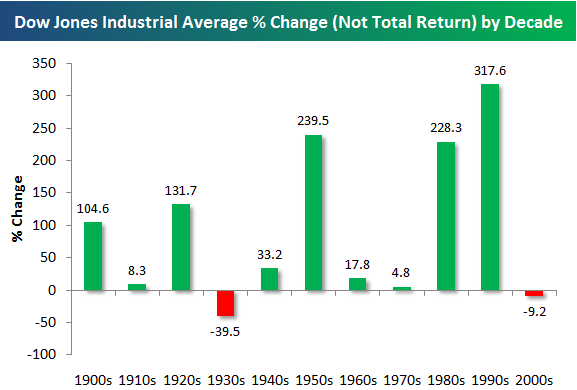
Along with the looks back at the 2000s, we'll also see plenty of stories touting stocks for the next decade in the coming months. Prognosticating just a year out is hard enough, much less a decade. Just ask the folks that made their projections for this decade back in 2000.
Below we highlight the stock picks for the next decade from two articles that came out in early 2000. The first table below shows the performance of Fortune's "10 Stocks to Last the Decade" that came out in its August 2000 issue. As shown, just one stock has gone up since then (also the only one to outperform the S&P 500), while two are out of business.
The second table shows the performance of stocks from a New York Times article on February 20, 2000 that asked 10 "top investors" for their top pick for 2010. These stocks did a little better than Fortune's picks, but not by much. Click here to read the article.
Investors can and do gain a lot of insight from outlook pieces, etc., but we feel that projecting out a decade is futile at best. We promise we won't be making any 2020 stock picks here at Bespoke!


Friday, November 27, 2009
Market timing
http://www.marketwatch.com/story/five-market-sectors-for-the-next-six-months-2009-11-13
SAN FRANCISCO (MarketWatch) -- Any investor who followed the old market adage to "Sell in May and go away" is probably feeling left behind, with the benchmark Standard & Poor's 500-stock index up 25% since the end of April.
No regrets; there may be more where that came from. The period from November through April historically has been the best six months of the year for U.S. stocks, and even better for the market's most cyclical sectors.
Sector investors win in winter
November through April has historically been the best period for U.S. stocks, but that six-month period is even better for the market's most cyclical sectors, says Sam Stovall, chief investment strategist at Standard & Poor's Equity Research. MarketWatch's Jonathan Burton reports.
"Whether you look back to 1990, 1970, 1945 or 1929, the S&P 500's /quotes/comstock/21z!i1:in\x (SPX 1,099, -12.12, -1.09%) performance from November through April substantially outperformed the market's typical price change from May through October," Sam Stovall, chief investment strategist at Standard & Poor's Equity Research, wrote in a recent report to clients.
Moreover, the S&P 500's cyclical, economically sensitive sectors have been the warmest places to invest through the winter. During this timeframe, the Industrials, Materials, Financials, Consumer Discretionary and Information Technology sectors traditionally recorded their strongest price gains and frequencies of beating the market.
Studies reinforce S&P's data. Two researchers at New Zealand's Massey University, Ben Jacobsen and Nuttawat Visaltanachoti, found that while all U.S. market sectors perform better in winter, the season is especially generous to stocks and sectors related to industrial production and raw materials than they are for companies tied to consumer consumption.
This timing tactic didn't work in 2008, of course, as stocks failed on almost every front. History, after all, is only a guide. Still, sector investors can use history to their advantage -- particularly since this calendar pattern, commonly known as the "Halloween Effect," is one persistent strategy that doesn't seem to get much credit. Said Stovall: "Who's going to arbitrage it away if nobody takes it seriously?"
Industrials
/quotes/comstock/13*!xli/quotes/nls/xli XLI 27.67, -0.29, -1.04%
/quotes/comstock/21z!i1:in\x SPX 1,099, -12.12, -1.09%
/quotes/comstock/21z!i1:in\x SPX 1,099, -12.12, -1.09%
40%
20%
0%
-20%
-40%
F
A
J
A
O
Since 1990, the S&P 500 Industrials sector has posted an average gain of 7.9% in the November through April period, versus a 5.9% advance for the broad index.
Industrials have been relatively quiet so far this year. The average industrials-focused mutual fund had gained slightly more than 20%, lagging the S&P 500's 23% return, according to investment researcher Morningstar Inc. A representative exchange-traded fund, Industrial Select Sector SPDR /quotes/comstock/13*!xli/quotes/nls/xli (XLI 27.67, -0.29, -1.04%) , has gained around 19%, while another entry, iShares Dow Jones US Industrial /quotes/comstock/13*!iyj/quotes/nls/iyj (IYJ 52.33, -0.51, -0.97%) , is up 22%.
Industrials' lackluster performance encourages David Kudla, chief investment strategist at financial advisory firm Mainstay Capital Management. He's bullish on the sector's prospects, particularly for corporate giants with a global footprint.
"Those large multinational exporters are going to benefit from government stimulus around the world and from a falling U.S. dollar," Kudla said, noting that he's also optimistic about the Technology and Materials sectors.
"It's hard for me to get away from the basic stuff," added Hugh Johnson, chief investment officer at money manager Johnson Illington Advisors. His favorite Industrials stocks include Caterpillar Inc. /quotes/comstock/13*!cat/quotes/nls/cat (CAT 58.28, -0.76, -1.29%) and Deere Co. /quotes/comstock/13*!de/quotes/nls/de (DE 53.08, -0.62, -1.16%)
Two specialized Fidelity mutual funds have been sector standouts. Fidelity Select Industrials Fund /quotes/comstock/10r!fcyix (FCYIX 17.82, +0.10, +0.56%) was up 33% through Nov. 13, while sibling Fidelity Select Industrial Equipment Fund gained 34%.
Materials
/quotes/comstock/13*!xlb/quotes/nls/xlb XLB 32.66, -0.46, -1.39%
/quotes/comstock/21z!i1:in\x SPX 1,099, -12.12, -1.09%
/quotes/comstock/21z!i1:in\x SPX 1,099, -12.12, -1.09%
5
A
J
A
O
The Materials sector has enjoyed an average 9.7% gain from November through April since 1990, according to S&P.
This year the commodity-heavy sector has been on a tear. Materials Select Sector SPDR /quotes/comstock/13*!xlb/quotes/nls/xlb (XLB 32.66, -0.46, -1.39%) , for example, is up 42%, including an 8.5% gain in the first 10 days of November alone. The ETFs largest holdings include Monsanto Co. /quotes/comstock/13*!mon/quotes/nls/mon (MON 79.41, -1.46, -1.81%) and Freeport-McMoRan Copper & Gold Inc. /quotes/comstock/13*!fcx/quotes/nls/fcx (FCX 85.54, -1.78, -2.04%)
Will China dump the dollar?
The U.S. dollar is on our minds these days because it is weak and getting weaker. We hear reports that Chinese officials are actively cautioning, scolding and remonstrating the U.S. on its profligate ways because China has an estimated $2 trillion+ in reserves, much of it invested in dollar-denominated securities.
The falling dollar and China’s concerns raise questions, one of which is, “Will China dump the dollar?” For investors, I believe a better question is, “Can China dump the dollar?”
Role reversal
In the U.S., debt is growing and our government is moving further and further into the private sectors of the economy. On the other hand, the supposedly communist country of China is exhorting us to be more responsible and prudent by cutting spending and balancing our budget. Interesting times aren’t they?
Are investors declining the dollar?
The concerns about the U.S. dollar impact our decisions as investors on many fronts, including such basic issues as the percentage of foreign stocks or bonds to hold. But, from the standpoint of foreign investors, assets in America are on sale to the extent their currencies have appreciated versus the dollar. So, our loss is their gain.
Chinese currency choices
In terms of foreign currencies, I believe there are only two others — the Euro and the Japanese Yen — that China could look to other than the dollar. China’s financial reserves are big enough that the Chinese government has to have its foreign assets denominated in a very large, liquid currency. And, there are not too many of those around other than the U.S. dollar, the Euro and the Yen.
For a variety of historical and cultural reasons, I doubt if the Chinese would seriously entertain putting most of their foreign currency and foreign assets holdings in the Japanese Yen, so the currency choice is between the dollar and the Euro.

Source: Wikipedia Commons
The Chinese are investing in the Euro, but that is happening in an incremental fashion. As long as the U.S. remains a significant trading partner for China’s exports, the dollar will be a major currency for Chinese central bank activities. There are those who think the Chinese will dump the dollar and buy Euros on a wholesale basis, but as I point out below, that is unlikely. However, one other choice is appearing — commodities.
Commodities as a currency alternative
In terms of alternatives for China, there is some evidence that China is stockpiling commodities such as oil and copper as a hedge against inflation and the falling dollar.
Here is a post from Brad Setser, written on his Follow the Money blog (China’s new barbell portfolio: Treasuries and commodities?) in which he discussed China’s dual strategy of buying Treasuries and commodities. Incidentally, Setser is now a senior member of the White House’s National Economic Council. He wrote:
…At the same time, China has sought to ramp up its exposure to commodities. China’s government clearly is adding to its strategic stockpiles — and perhaps encouraging state firms to build up inventory as well. China’s government is encouraging Chinese state firms to invest more abroad, especially in the mining sector. And China’s government is providing financing to cash-strapped commodity exporters (Russia, Kazakhstan, Brazil and no doubt others) to help tide them through a rough patch and, China hopes, to secure future supplies…
However, investing in the volatile commodity market is not without risk for China either, so they are faced with a variety of choices, none of which are without risk.
What if?
Just to finish the thought, what if China did dump the dollar in a significant way? The implications of that are obviously negative for the U.S. economy as the dollar would fall even further under the selling pressure. And, other countries, along with large investors would probably sell dollars, putting more pressure on it. In order to shore up the dollar, the Federal Reserve would be forced to raise short-term interest rates and, though that would help the dollar, it would hurt the economy.
However, consider how these events would affect China. Selling its stake in dollar-denominated securities is something that would take years. So, a precipitous fall in the dollar would reduce the value of all dollar-based securities China continued to hold. Also, assuming the U.S. economy softened under this scenario, exports to America would dry up quite a bit.
Finally, there would be intense political pressure in the U.S. to retaliate by slapping tariffs on Chinese goods and taking other punitive measures. In short, China would also suffer a great deal if it tried to dump the dollar.
What’s next for the dollar?
The big difficulty we face now is that the economy is weak and the Fed likes to have low interest rates to help the economy begin to grow again. Low interest rates are helpful to overall economic activity, but low rates generally hurt the dollar.
If we wanted to help out the weak dollar, the response would ideally be to raise interest rates. However, due to serious weakness in the economy, the Fed is hampered in its ability to respond to this situation and I believe it will opt to keep interest rates low well into 2010 in order to promote economic growth.
You may hear various politicians or pundits decrying the weak dollar. However, for decades, our government’s philosophy during recessions has been to publicly espouse a strong dollar while, at the same time, cutting interest rates to strengthen the economy and give unemployment a boost. This has traditionally been done despite the fact that lower interest rates generally lead to a weaker dollar. I don’t see anything in the cards that appears to have changed that policy. Therefore, I expect continued pressure on the dollar as the Fed seeks to get economic activity going again.
Huge deficits mean more pressure on the dollar
With huge budget deficits as far as the eye can see, the U.S. Treasury has to issue enormous amounts of Treasury securities. To absorb these securities, the Treasury needs buyers. So, we need China to continue investing. As a result, U.S. fiscal and monetary policy will be increasingly tied to keeping China happy. It enforces a discipline of sorts, but our policy options are going to be increasingly limited and necessarily reactive, rather than pro-active.
The road ahead
The dollar is likely to be weak until the Fed starts raising interest rates, which won’t happen until later next year. So, we will continue to hear lots of noise from Washington and parts eastward about the dollar, but I do not think anything drastic will happen soon.
As long as this low interest rate trend continues, the dollar will weaken. And, assets such as stocks, bonds or gold will hold up better than the dollar. However, when the dollar snaps back, as it will (if even temporarily), the move will be very quick.
Just think back to the dollar rebound last fall and earlier this year to get a sense of what could happen. So, be wary of any investment strategy that is built entirely on the prospect of a permanently weak dollar.
See also:
Thursday, November 26, 2009
Invest now to end of 2009
Goldman is increasingly confident in the end of year rally. In fact, a recent piece of research says December could be one of the strongest months of 2009 (not an easy feat considering the year we’ve had). Like other bullish investors, they believe seasonality will be an important influence on year-end action:
As we move into the year end, we take a look at the seasonality effect in equity markets. December stands out as one of the best months for equities, using both long- and short-term data; we think this year will be similar. In years when the first 11 months have yielded good returns, December has tended to be particularly strong.
December yields good returns on average
Based on monthly data going back to 1974, December has on average returned twice as much as the monthly average (1.7% vs. 0.8%). It is the third best month based on average data and the second best one using median data. It is interesting to note that January is also a good month for equities based on long-term data. December and January both yielded a positive return in more than 70% of the cases.
Goldman goes on to note that December is particularly strong when the current year has been strong:
The better the year, the better the December
There have been worries among market participants that the year end could see weakness in equities, following the strong year-to-date performance. However, historical data tell the opposite. In years when the return from January to November has been strong, December has tended to be very strong as well.
How to play it? Don’t rely on commodities to continue their inverse dollar surge. In fact, the best performing assets in big years have been financials cyclicals:
Oil & Gas has underperformed historically in December
Commodity related sectors exhibit the lowest relative returns among all sectors in December. This holds even when restricting the sample to years when the market went up by more than 20% in the run-up to December. Conversely, Financials and selected Cyclicals have been the best performing sectors in December when the market has risen by more than 20% in the first 11 months. Looking at countries, the results are less interesting as the differentiation is less marked than between sectors. Germany stands out as the best performing country on average in
December.Conditional seasonality: The better the year, the stronger the December
Recently, there has been a lot of talk in the investor community about de-risking and investors locking in their performance for the year. This has resulted in more bearishness going into the year end, as many have questioned the potential for further market upside based on the sustainability of the economic recovery. A seasonal analysis conditional on year-to-date performance tells a very different story. The better the performance has been from January to November, the more positive the return has tended to be in December (Exhibit 5).
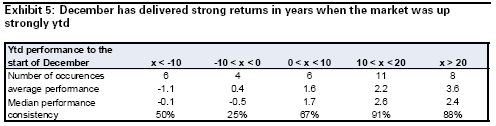
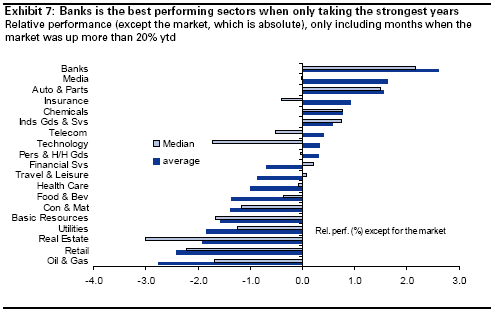
Where to play it? Italy and Germany have been the best performers:
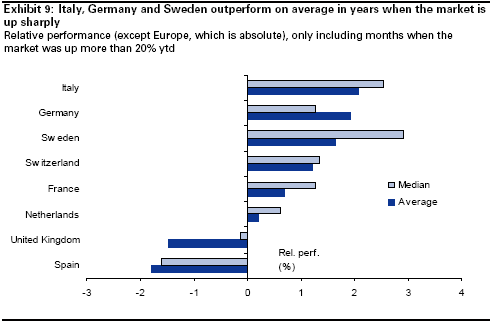
Tuesday, November 24, 2009
Are emerging markets the next bubble?
NEW YORK (Money) -- Question: I'm considering investing in emerging markets mutual funds. But do you think that's a good idea, or are they just going to be the next investment bubble? -- Mario, Atlanta, Georgia
Answer: Last year, The Onion ran a hilarious"news" story about a panel of business leaders appearing before Congress to demand that "the government provide Americans with a new irresponsible and largely illusory economic bubble in which to invest."
The article was satire, of course. But what made it so funny was that it hit so close to the truth. It seems we just aren't comfortable unless we can pour our money into something that offers unsustainable returns.
And indeed, given how we've careened from one bubble to another over the past decade -- technology shares to Internet IPOs to residential and commercial real estate to mortgage-backed securities -- you can't help but wonder which investment we'll next infuse with unrealistic expectations that will eventually give way to bitter disappointment and big losses.
Will it be, as you suggest, emerging markets funds, which have already gained a bubblicious 69% for the year to date? Or how about high-yield bond funds? They're up an attention-grabbing 42% so far this year.
Or will old reliable gold step up again? It's already breached the$1,150-an-ounce mark this year and some gold bulls are saying there's no end in sight.
Truth is, though, while it's easy to identify bubbles after they burst, it's hard to know for sure whether you're in one while it's still inflating. You can suspect that returns may be too frothy. But there's always some rationale that not only justifies prices, but suggests why they've got a lot more room to run.
Detecting a bubble
So I don't think it's possible to come up with a foolproof Bubble Detector. That said, I think there are three fairly simple defenses that should at least be able to limit the damage a bubble can do to you.
The first is common sense. Yes, I know it's gone out of vogue in an age where we're supposed to defer to pros in every aspect of our lives. But stepping back from the hurly burly of the investing scene and applying a little old-fashioned independent judgment can often provide a helpful bit of perspective.
Take emerging markets funds. They're up more than 120% since their November 2008 lows. That fact alone doesn't mean they can't gain even more. But you don't have to be an investing genius to know that this sort of sizzle will eventually fizzle. And if you look at the history of these funds, you'll see that they have a habit of generating colossal gains that are followed by huge setbacks.
But reversion to the mean applies not just to emerging markets funds. I'd say you should be wary any time an investment soars to truly outsize returns, especially if people begin piling into that investment like so many lemmings.
For example, seemingly unstoppable price increases triggered a feeding frenzy in housing earlier this decade, which prompted me to write a column warning people about loading up their IRAs with residential real estate. Did I know we were on the verge of a housing bust? No. But I knew that the combination of overheated prices and an insatiable appetite on the part of investors to throw even more money into the sector should make someone more wary than enthusiastic about jumping into real estate with the expectation of continued blockbuster gains.
The second defense is building a balanced portfolio. True, diversifying won't immunize you from bubbles. In fact, the more broadly diversified you are, the more likely you'll own an investment that goes into bubble mode.
But diversification does provide protection in that spreading your money among different types of investments rather than making a big bet on one investment you hope will deliver spectacular gains limits the potential for damage. Part of your portfolio might deflate, but not the whole thing.
So while I don't advocate investing in emerging markets funds because they've recently racked up impressive returns, one can make a case for owning them to diversify an already diversified portfolio even more.
A possible long-term investment
Even then, I'd argue that you should consider flighty investments like emerging markets funds only if you're planning to own them for a long time, say at least 10 years. They're too volatile in my opinion for shorter holding periods. And I'd also recommend limiting your exposure. Highly volatile investments like emerging markets, high-yield bonds and gold are more like spices than main courses, so a little goes a long way. In the case of gold, you're talking maybe 5% to 10% of your overall holdings. In the case of emerging markets funds and high-yield bonds, it's probably more like 10% to 20% of your international and bond holdings respectively.
Your third tier of defense is rebalancing, or selling a portion of investments that have outperformed and plowing the proceeds into those that have lagged to bring your portfolio back to its correct proportions every year or so.
This technique prevents any single investment from becoming too big a part of your portfolio when it's on a roll. It also forces you to be a bit of a contrarian, selling off some of your emerging markets after a year during which they've had a big run-up and buying in after they've taken a beating. Put another way, it allows you to buy low and sell high, which is something investors know they should do, but too often lack the will to pull off.
So to answer your question, I think investing in emerging markets funds can be a good idea if you're doing it for the right reason (more diversification) and the right way (small portions that are part of a long-term asset allocation and rebalancing strategy). That said, I don't think anyone should feel compelled to add emerging markets funds to his or her portfolio. You can do perfectly well without them.
As for the bubble issue, I don't believe there's any way to know for sure if emerging markets funds are now in or will soon reach bubble status. But if money continues to flow into these funds mostly because investors are chasing past gains as opposed to building a better rounded portfolio, we could very well be headed toward another bubble, and, of course, a resounding pop!
Subscribe to:
Comments (Atom)