Friday, November 27, 2009

Market timing


http://www.marketwatch.com/story/five-market-sectors-for-the-next-six-months-2009-11-13

SAN FRANCISCO (MarketWatch) -- Any investor who followed the old market adage to "Sell in May and go away" is probably feeling left behind, with the benchmark Standard & Poor's 500-stock index up 25% since the end of April.

No regrets; there may be more where that came from. The period from November through April historically has been the best six months of the year for U.S. stocks, and even better for the market's most cyclical sectors.

Sector investors win in winter

November through April has historically been the best period for U.S. stocks, but that six-month period is even better for the market's most cyclical sectors, says Sam Stovall, chief investment strategist at Standard & Poor's Equity Research. MarketWatch's Jonathan Burton reports.

"Whether you look back to 1990, 1970, 1945 or 1929, the S&P 500's /quotes/comstock/21z!i1:in\x (SPX 1,099, -12.12, -1.09%) performance from November through April substantially outperformed the market's typical price change from May through October," Sam Stovall, chief investment strategist at Standard & Poor's Equity Research, wrote in a recent report to clients.

Moreover, the S&P 500's cyclical, economically sensitive sectors have been the warmest places to invest through the winter. During this timeframe, the Industrials, Materials, Financials, Consumer Discretionary and Information Technology sectors traditionally recorded their strongest price gains and frequencies of beating the market.

Studies reinforce S&P's data. Two researchers at New Zealand's Massey University, Ben Jacobsen and Nuttawat Visaltanachoti, found that while all U.S. market sectors perform better in winter, the season is especially generous to stocks and sectors related to industrial production and raw materials than they are for companies tied to consumer consumption.

This timing tactic didn't work in 2008, of course, as stocks failed on almost every front. History, after all, is only a guide. Still, sector investors can use history to their advantage -- particularly since this calendar pattern, commonly known as the "Halloween Effect," is one persistent strategy that doesn't seem to get much credit. Said Stovall: "Who's going to arbitrage it away if nobody takes it seriously?"

Industrials

/quotes/comstock/13*!xli/quotes/nls/xli XLI 27.67, -0.29, -1.04%
/quotes/comstock/21z!i1:in\x SPX 1,099, -12.12, -1.09%
40%
20%
0%
-20%
-40%
F
A
J
A
O

Since 1990, the S&P 500 Industrials sector has posted an average gain of 7.9% in the November through April period, versus a 5.9% advance for the broad index.

Industrials have been relatively quiet so far this year. The average industrials-focused mutual fund had gained slightly more than 20%, lagging the S&P 500's 23% return, according to investment researcher Morningstar Inc. A representative exchange-traded fund, Industrial Select Sector SPDR /quotes/comstock/13*!xli/quotes/nls/xli (XLI 27.67, -0.29, -1.04%) , has gained around 19%, while another entry, iShares Dow Jones US Industrial /quotes/comstock/13*!iyj/quotes/nls/iyj (IYJ 52.33, -0.51, -0.97%) , is up 22%.

Industrials' lackluster performance encourages David Kudla, chief investment strategist at financial advisory firm Mainstay Capital Management. He's bullish on the sector's prospects, particularly for corporate giants with a global footprint.

"Those large multinational exporters are going to benefit from government stimulus around the world and from a falling U.S. dollar," Kudla said, noting that he's also optimistic about the Technology and Materials sectors.

"It's hard for me to get away from the basic stuff," added Hugh Johnson, chief investment officer at money manager Johnson Illington Advisors. His favorite Industrials stocks include Caterpillar Inc. /quotes/comstock/13*!cat/quotes/nls/cat (CAT 58.28, -0.76, -1.29%) and Deere Co. /quotes/comstock/13*!de/quotes/nls/de (DE 53.08, -0.62, -1.16%)

Two specialized Fidelity mutual funds have been sector standouts. Fidelity Select Industrials Fund /quotes/comstock/10r!fcyix (FCYIX 17.82, +0.10, +0.56%) was up 33% through Nov. 13, while sibling Fidelity Select Industrial Equipment Fund gained 34%.

Materials

/quotes/comstock/13*!xlb/quotes/nls/xlb XLB 32.66, -0.46, -1.39%
/quotes/comstock/21z!i1:in\x SPX 1,099, -12.12, -1.09%
5
A
J
A
O

The Materials sector has enjoyed an average 9.7% gain from November through April since 1990, according to S&P.

This year the commodity-heavy sector has been on a tear. Materials Select Sector SPDR /quotes/comstock/13*!xlb/quotes/nls/xlb (XLB 32.66, -0.46, -1.39%) , for example, is up 42%, including an 8.5% gain in the first 10 days of November alone. The ETFs largest holdings include Monsanto Co. /quotes/comstock/13*!mon/quotes/nls/mon (MON 79.41, -1.46, -1.81%) and Freeport-McMoRan Copper & Gold Inc. /quotes/comstock/13*!fcx/quotes/nls/fcx (FCX 85.54, -1.78, -2.04%)

Will China dump the dollar?

The U.S. dollar is on our minds these days because it is weak and getting weaker. We hear reports that Chinese officials are actively cautioning, scolding and remonstrating the U.S. on its profligate ways because China has an estimated $2 trillion+ in reserves, much of it invested in dollar-denominated securities.

The falling dollar and China’s concerns raise questions, one of which is, “Will China dump the dollar?” For investors, I believe a better question is, “Can China dump the dollar?”

Role reversal

In the U.S., debt is growing and our government is moving further and further into the private sectors of the economy. On the other hand, the supposedly communist country of China is exhorting us to be more responsible and prudent by cutting spending and balancing our budget. Interesting times aren’t they?

Are investors declining the dollar?

The concerns about the U.S. dollar impact our decisions as investors on many fronts, including such basic issues as the percentage of foreign stocks or bonds to hold. But, from the standpoint of foreign investors, assets in America are on sale to the extent their currencies have appreciated versus the dollar. So, our loss is their gain.

Chinese currency choices

In terms of foreign currencies, I believe there are only two others — the Euro and the Japanese Yen — that China could look to other than the dollar. China’s financial reserves are big enough that the Chinese government has to have its foreign assets denominated in a very large, liquid currency. And, there are not too many of those around other than the U.S. dollar, the Euro and the Yen.

For a variety of historical and cultural reasons, I doubt if the Chinese would seriously entertain putting most of their foreign currency and foreign assets holdings in the Japanese Yen, so the currency choice is between the dollar and the Euro.

wikipedia-commons-euro-banknoten.jpg

Source: Wikipedia Commons

The Chinese are investing in the Euro, but that is happening in an incremental fashion. As long as the U.S. remains a significant trading partner for China’s exports, the dollar will be a major currency for Chinese central bank activities. There are those who think the Chinese will dump the dollar and buy Euros on a wholesale basis, but as I point out below, that is unlikely. However, one other choice is appearing — commodities.

Commodities as a currency alternative

In terms of alternatives for China, there is some evidence that China is stockpiling commodities such as oil and copper as a hedge against inflation and the falling dollar.

Here is a post from Brad Setser, written on his Follow the Money blog (China’s new barbell portfolio: Treasuries and commodities?) in which he discussed China’s dual strategy of buying Treasuries and commodities. Incidentally, Setser is now a senior member of the White House’s National Economic Council. He wrote:

…At the same time, China has sought to ramp up its exposure to commodities. China’s government clearly is adding to its strategic stockpiles — and perhaps encouraging state firms to build up inventory as well. China’s government is encouraging Chinese state firms to invest more abroad, especially in the mining sector. And China’s government is providing financing to cash-strapped commodity exporters (Russia, Kazakhstan, Brazil and no doubt others) to help tide them through a rough patch and, China hopes, to secure future supplies…

However, investing in the volatile commodity market is not without risk for China either, so they are faced with a variety of choices, none of which are without risk.

What if?

Just to finish the thought, what if China did dump the dollar in a significant way? The implications of that are obviously negative for the U.S. economy as the dollar would fall even further under the selling pressure. And, other countries, along with large investors would probably sell dollars, putting more pressure on it. In order to shore up the dollar, the Federal Reserve would be forced to raise short-term interest rates and, though that would help the dollar, it would hurt the economy.

However, consider how these events would affect China. Selling its stake in dollar-denominated securities is something that would take years. So, a precipitous fall in the dollar would reduce the value of all dollar-based securities China continued to hold. Also, assuming the U.S. economy softened under this scenario, exports to America would dry up quite a bit.

Finally, there would be intense political pressure in the U.S. to retaliate by slapping tariffs on Chinese goods and taking other punitive measures. In short, China would also suffer a great deal if it tried to dump the dollar.

What’s next for the dollar?

The big difficulty we face now is that the economy is weak and the Fed likes to have low interest rates to help the economy begin to grow again. Low interest rates are helpful to overall economic activity, but low rates generally hurt the dollar.

If we wanted to help out the weak dollar, the response would ideally be to raise interest rates. However, due to serious weakness in the economy, the Fed is hampered in its ability to respond to this situation and I believe it will opt to keep interest rates low well into 2010 in order to promote economic growth.

You may hear various politicians or pundits decrying the weak dollar. However, for decades, our government’s philosophy during recessions has been to publicly espouse a strong dollar while, at the same time, cutting interest rates to strengthen the economy and give unemployment a boost. This has traditionally been done despite the fact that lower interest rates generally lead to a weaker dollar. I don’t see anything in the cards that appears to have changed that policy. Therefore, I expect continued pressure on the dollar as the Fed seeks to get economic activity going again.

Huge deficits mean more pressure on the dollar

With huge budget deficits as far as the eye can see, the U.S. Treasury has to issue enormous amounts of Treasury securities. To absorb these securities, the Treasury needs buyers. So, we need China to continue investing. As a result, U.S. fiscal and monetary policy will be increasingly tied to keeping China happy. It enforces a discipline of sorts, but our policy options are going to be increasingly limited and necessarily reactive, rather than pro-active.

The road ahead

The dollar is likely to be weak until the Fed starts raising interest rates, which won’t happen until later next year. So, we will continue to hear lots of noise from Washington and parts eastward about the dollar, but I do not think anything drastic will happen soon.

As long as this low interest rate trend continues, the dollar will weaken. And, assets such as stocks, bonds or gold will hold up better than the dollar. However, when the dollar snaps back, as it will (if even temporarily), the move will be very quick.

Just think back to the dollar rebound last fall and earlier this year to get a sense of what could happen. So, be wary of any investment strategy that is built entirely on the prospect of a permanently weak dollar.

See also:

S&P gains, but dollar falls

Thursday, November 26, 2009

Invest now to end of 2009

Goldman is increasingly confident in the end of year rally. In fact, a recent piece of research says December could be one of the strongest months of 2009 (not an easy feat considering the year we’ve had). Like other bullish investors, they believe seasonality will be an important influence on year-end action:

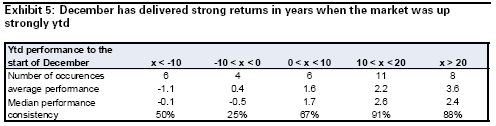
As we move into the year end, we take a look at the seasonality effect in equity markets. December stands out as one of the best months for equities, using both long- and short-term data; we think this year will be similar. In years when the first 11 months have yielded good returns, December has tended to be particularly strong.

December yields good returns on average
Based on monthly data going back to 1974, December has on average returned twice as much as the monthly average (1.7% vs. 0.8%). It is the third best month based on average data and the second best one using median data. It is interesting to note that January is also a good month for equities based on long-term data. December and January both yielded a positive return in more than 70% of the cases.

Goldman goes on to note that December is particularly strong when the current year has been strong:

The better the year, the better the December
There have been worries among market participants that the year end could see weakness in equities, following the strong year-to-date performance. However, historical data tell the opposite. In years when the return from January to November has been strong, December has tended to be very strong as well.

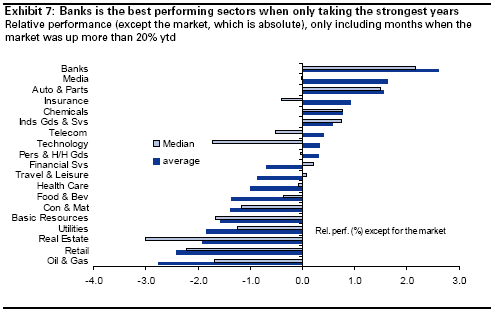
How to play it? Don’t rely on commodities to continue their inverse dollar surge. In fact, the best performing assets in big years have been financials cyclicals:

Oil & Gas has underperformed historically in December
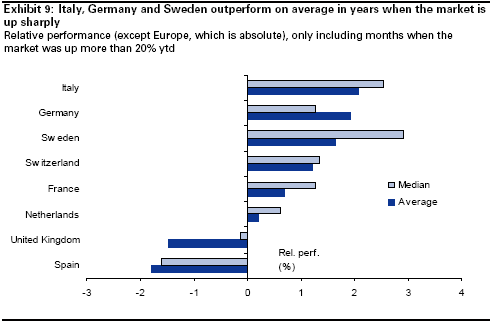
Commodity related sectors exhibit the lowest relative returns among all sectors in December. This holds even when restricting the sample to years when the market went up by more than 20% in the run-up to December. Conversely, Financials and selected Cyclicals have been the best performing sectors in December when the market has risen by more than 20% in the first 11 months. Looking at countries, the results are less interesting as the differentiation is less marked than between sectors. Germany stands out as the best performing country on average in
December.

Conditional seasonality: The better the year, the stronger the December
Recently, there has been a lot of talk in the investor community about de-risking and investors locking in their performance for the year. This has resulted in more bearishness going into the year end, as many have questioned the potential for further market upside based on the sustainability of the economic recovery. A seasonal analysis conditional on year-to-date performance tells a very different story. The better the performance has been from January to November, the more positive the return has tended to be in December (Exhibit 5).

 GOLDMAN SACHS: HOW TO TRADE THE END OF THE YEAR

 GOLDMAN SACHS: HOW TO TRADE THE END OF THE YEAR

Where to play it? Italy and Germany have been the best performers:

 GOLDMAN SACHS: HOW TO TRADE THE END OF THE YEAR

Tuesday, November 24, 2009

Are emerging markets the next bubble?

NEW YORK (Money) -- Question: I'm considering investing in emerging markets mutual funds. But do you think that's a good idea, or are they just going to be the next investment bubble? -- Mario, Atlanta, Georgia

Answer: Last year, The Onion ran a hilarious"news" story about a panel of business leaders appearing before Congress to demand that "the government provide Americans with a new irresponsible and largely illusory economic bubble in which to invest."

The article was satire, of course. But what made it so funny was that it hit so close to the truth. It seems we just aren't comfortable unless we can pour our money into something that offers unsustainable returns.

And indeed, given how we've careened from one bubble to another over the past decade -- technology shares to Internet IPOs to residential and commercial real estate to mortgage-backed securities -- you can't help but wonder which investment we'll next infuse with unrealistic expectations that will eventually give way to bitter disappointment and big losses.

Will it be, as you suggest, emerging markets funds, which have already gained a bubblicious 69% for the year to date? Or how about high-yield bond funds? They're up an attention-grabbing 42% so far this year.

Or will old reliable gold step up again? It's already breached the$1,150-an-ounce mark this year and some gold bulls are saying there's no end in sight.

Truth is, though, while it's easy to identify bubbles after they burst, it's hard to know for sure whether you're in one while it's still inflating. You can suspect that returns may be too frothy. But there's always some rationale that not only justifies prices, but suggests why they've got a lot more room to run.

Detecting a bubble

So I don't think it's possible to come up with a foolproof Bubble Detector. That said, I think there are three fairly simple defenses that should at least be able to limit the damage a bubble can do to you.

The first is common sense. Yes, I know it's gone out of vogue in an age where we're supposed to defer to pros in every aspect of our lives. But stepping back from the hurly burly of the investing scene and applying a little old-fashioned independent judgment can often provide a helpful bit of perspective.

Take emerging markets funds. They're up more than 120% since their November 2008 lows. That fact alone doesn't mean they can't gain even more. But you don't have to be an investing genius to know that this sort of sizzle will eventually fizzle. And if you look at the history of these funds, you'll see that they have a habit of generating colossal gains that are followed by huge setbacks.

But reversion to the mean applies not just to emerging markets funds. I'd say you should be wary any time an investment soars to truly outsize returns, especially if people begin piling into that investment like so many lemmings.

For example, seemingly unstoppable price increases triggered a feeding frenzy in housing earlier this decade, which prompted me to write a column warning people about loading up their IRAs with residential real estate. Did I know we were on the verge of a housing bust? No. But I knew that the combination of overheated prices and an insatiable appetite on the part of investors to throw even more money into the sector should make someone more wary than enthusiastic about jumping into real estate with the expectation of continued blockbuster gains.

The second defense is building a balanced portfolio. True, diversifying won't immunize you from bubbles. In fact, the more broadly diversified you are, the more likely you'll own an investment that goes into bubble mode.

But diversification does provide protection in that spreading your money among different types of investments rather than making a big bet on one investment you hope will deliver spectacular gains limits the potential for damage. Part of your portfolio might deflate, but not the whole thing.

So while I don't advocate investing in emerging markets funds because they've recently racked up impressive returns, one can make a case for owning them to diversify an already diversified portfolio even more.

A possible long-term investment

Even then, I'd argue that you should consider flighty investments like emerging markets funds only if you're planning to own them for a long time, say at least 10 years. They're too volatile in my opinion for shorter holding periods. And I'd also recommend limiting your exposure. Highly volatile investments like emerging markets, high-yield bonds and gold are more like spices than main courses, so a little goes a long way. In the case of gold, you're talking maybe 5% to 10% of your overall holdings. In the case of emerging markets funds and high-yield bonds, it's probably more like 10% to 20% of your international and bond holdings respectively.

Your third tier of defense is rebalancing, or selling a portion of investments that have outperformed and plowing the proceeds into those that have lagged to bring your portfolio back to its correct proportions every year or so.

This technique prevents any single investment from becoming too big a part of your portfolio when it's on a roll. It also forces you to be a bit of a contrarian, selling off some of your emerging markets after a year during which they've had a big run-up and buying in after they've taken a beating. Put another way, it allows you to buy low and sell high, which is something investors know they should do, but too often lack the will to pull off.

So to answer your question, I think investing in emerging markets funds can be a good idea if you're doing it for the right reason (more diversification) and the right way (small portions that are part of a long-term asset allocation and rebalancing strategy). That said, I don't think anyone should feel compelled to add emerging markets funds to his or her portfolio. You can do perfectly well without them.

As for the bubble issue, I don't believe there's any way to know for sure if emerging markets funds are now in or will soon reach bubble status. But if money continues to flow into these funds mostly because investors are chasing past gains as opposed to building a better rounded portfolio, we could very well be headed toward another bubble, and, of course, a resounding pop! To top of page

Monday, November 23, 2009

The US Economy And Stock Market Continue To Act Disjointed

The current stock market continues to be disjointed from the real U.S. economy. It feels like the current government statistics are orchestrated propaganda. The credit-dependent, consumer-dependent U.S. economy is going down, and the trillions of dollars borrowed and spent by the U.S. government and Federal Reserve to start up a recovery has basically fallen flat.

The US economy needed several trillion of dollars in deficit spending to pull off the meager jobless growth of 2001-2007.The U.S. economy has been dependent on Federal stimulus for years now, both the indirect stimulus of artificially low interest rates, unlimited liquidity, and the direct spending of hundreds of billions of borrowed dollars. Even before the financial crisis of 2008-2009, the Federal government was borrowing and spending $400 billion a year to prop up the US economy to look prosperous.

The primary fuel that supports the U.S. economy is consumer spending which is ultimately based on household income and assets. The US economy is dependent on consumer spending for 70% of the GDP. Earned income has been flat to down for most Americans for years. According to the Bureau of Economic Analysis, real disposable personal income adjusted for inflation and taxes declined 3.4% in the third quarter.

In an economy dependent on consumer spending for 70% of GDP, how can GDP rise by 3.5% while personal income plummeted by 3.4%? If the boost in GDP is real and not just statistical then where did it come from? The answer is from borrowed money. The Federal government borrowed and spent over $1.4 trillion in fiscal year 2009.

During the housing bubble of 2002-2007 households borrowed and spent hundreds of billions. But the consumer, beset by declining assets ($13 trillion lost in the past two years), declining income, falling housing values and horrible employment trends (17.5% unemployment/underemployment, broadly measured). Also add into the mix declining available credit.

Revolving credit (credit cards) decreased at an annual rate of 13%, and non-revolving credit. So while households are still burdened with almost $2.5 trillion in credit card and non-revolving debt, they are paying debt down, not adding more. Less debt spending by consumers means less spending to drive the GDP. And let's not forget that homeowners pulled out about $5 trillion in home equity during 2001-2007, and the home equity ATM has been closed by banks for a majority of Americans even those with excellent credit.

The primary asset for most Americans is a home, and home values are still dropping, foreclosures are still rising and the only force keeping the market from falling faster is the Federal government's quasi nationalization of the entire U.S. mortgage market.

Of the $1.5 trillion mortgage securities issued in 2009 over 90% are backed by the government. The government owns over half the nation's $10 trillion in mortgages via quasi ownership of Fannie Mae (FNMStock Charts and Research Links: 1.01, -0.01) and Freddie Mac (FREStock Charts and Research Links: 1.16, 0.02), and it has guaranteed virtually all the mortgages originated in the past year via FHA or VA. Should the Fed reduce their subsidies via the $8,000 tax credit to new home buyers and artificially low mortgage rates the current bounce in the housing market would grind to a halt.

Earning surprises with higher profits, is there real growth going on? By slashing payrolls, R&D and various accounting tricks. Actual revenue growth is still missing in action for the most part. Once the cost cutting activates have run there course it will be much harder for upside surprise earning announcements without true revenue growth. The stock market is rising on the hopes of an actual, real, tangible recovery in household income, home equity and creditworthiness. At some point soon investors will have to take pause and take a hard look under the hood of the US economy and it will not be a pretty site.

The mirage of recovery has been propping up the stock market for nine months I suspect that when investors see through the illusion the market will make a major retracement and head back near the March lows, or perhaps even lower. The major correction of 2010 will simply reflect the state of the real economy. 11/23/2009

Why a Market Crash Doesn’t Matter

Market Generalities

When reading Seeking Alpha Friday, I couldn’t help notice that the most popular article was: Why the Stock Market Should Crash, by Charles Hugh Smith. With all due respect to Mr. Smith, and all the other doomsayers out there, I frankly just don’t get it. In my opinion, fear is a negative emotion that causes more harm than good. My favorite acronym for FEAR is: False Evidence Appearing Real.

People who are worried about whether the stock market will crash or not are worried about a generality. In contrast, the world’s most successful investors are known to deal solely with specifics. Investing giants like Warren Buffett and Peter Lynch are on record as ignorers of the general stock market. Instead, they are only interested in the specific companies they own.

Regarding the stock market, there is also a lot of talk about the so-called “Lost Decade”. I will use the S&P 500 since calendar year 2000 as my proxy for the “Stock Market”, and its dreadful decade in this article. However, my contention is that unless you have all your liquid assets invested in the S&P 500 or some other passive index fund, the general market should be of little concern.

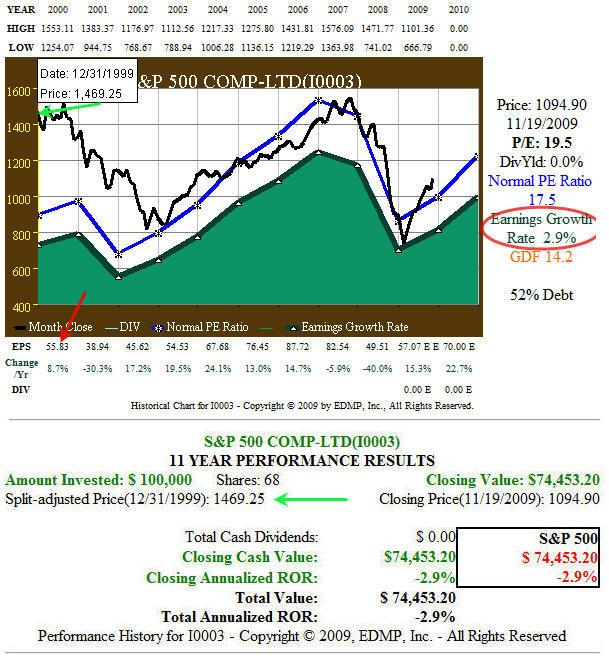
In Figure 1 below, we show the S&P 500 correlated to its earnings since 12/31/1999 to include performance. There are three key factors that are obvious from this graph:

  1. On 12/31/1999 the S&P 500 was at 1469 (green arrows) and was overvalued trading at more than 26 times earnings of $55.83 (red arrow.) Therefore, since the normal P/E ratio of the S&P 500 has been 17.5 for the past 20 years, future poor performance should have been expected.
  2. The rate of change of earnings growth for the S&P 500 of 2.9% (Red circle), was not strong enough to generate a positive return from such a lofty valuation.
  3. From calendar year 2000 to the current, we suffered through two recessions which created above-average cyclicality of earnings for the S&P 500. Clearly, earnings drive the long-term movement of stock price.

Figure 1 S&P 500: EPS Growth Correlated to Price and Price Performance

Figure 1 S&P 500: EPS Growth Correlated to Price and Price Performance

In his runaway national bestselling book "One Up on Wall Street", Peter Lynch devoted Chapter 5 to the thesis of my article titled “Is this a Good Market? Please don’t ask.” Mr. Lynch clearly and eloquently expressed his disdain for attempting to forecast the stock market. The following snippets from Chapter 5 illustrate the point:

If you must forecast,” an intelligent forecaster once said, “forecast often.”

What Stock Market?

The Market ought to be irrelevant. If I could convince you of this one thing, I’d feel this book had done its job. And if you don’t believe me, believe Warren Buffett, “As far as I am concerned,” Buffett has written, the stock market doesn’t exist. It is only there as a reference to see if anybody is offering to do anything foolish.”

Finally Mr. Lynch added:

I’d love to be able to predict markets and anticipate recessions, but since that’s impossible, I’m satisfied to search out profitable companies as Buffett is. I’ve made money even in lousy markets, and vice-versa. Several of my favorite tenbaggers made their biggest moves during bad markets.

Company Specifics

In the long run, earnings determine market price, and valuation plays a prominent role. Utilizing our Fundamentals-at-a-Glance research tool, I offer the following examples that validate the thesis and premises of this article. I will illustrate some stalwart like, solid growing businesses, and will sprinkle in a few powerhouse fast growers. Then I will add two examples of how overvaluation impacted returns even when earnings growth was strong.

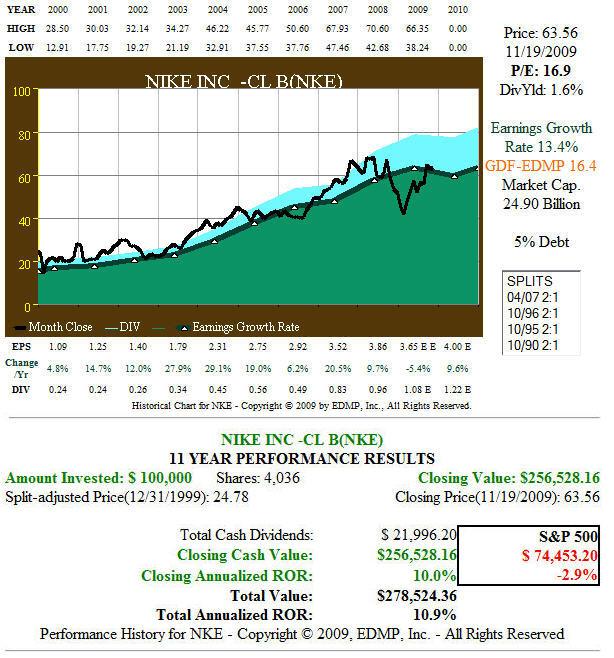
I start with Nike (NKE), Figure 2. Note that Nike’s stock price (black line) starts out slightly above the earnings line (green line with white triangles) implying modest overvaluation. However, earnings growth of 13.4% translates into annual 10% appreciation (excluding dividends) compared to a minus 2.9% annual loss for the S&P 500, or the stock market.

Figure 2 NKE: EPS Growth Correlated to Price and Price Performance

Figure 2 NKE: EPS Growth Correlated to Price and Price Performance

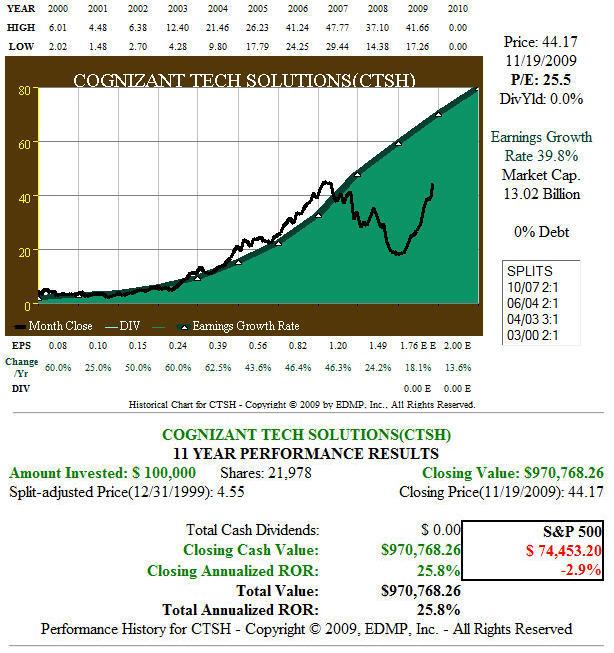
In Figure 3 we feature Cognizant Technologies Solutions (CTSH) a fast-growing outsourcer that has no debt and an earnings growth rate of almost 40% (39.8%). Clearly, the stock market had absolutely nothing to do with the returns that Cognizant shareholders enjoyed.

Figure 3 CTSH: EPS Growth Correlated to Price and Price Performance

Figure 3 CTSH: EPS Growth Correlated to Price and Price Performance

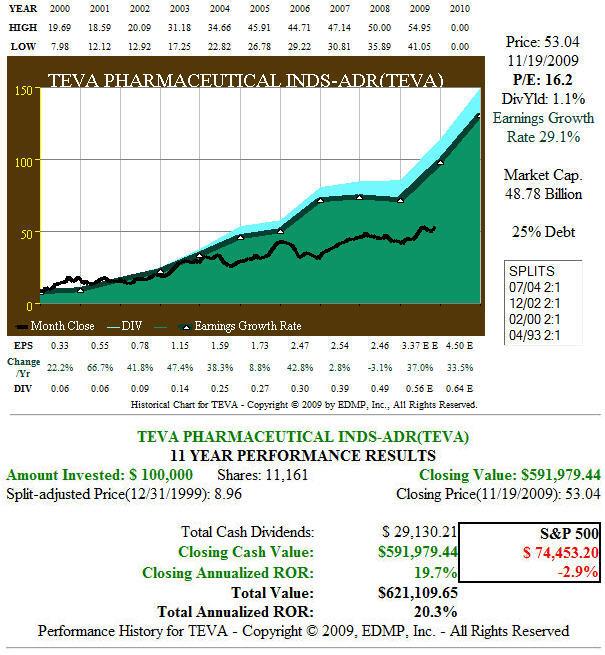
Figure 4 features TEVA Pharmaceutical Industries (TEVA), an Israel based ADR, the largest generic drug developer in the world. With earnings growth over 29% per year, TEVA shareholders enjoyed annual appreciation of almost 20% even though their stock price (black line) is currently at a discount to earnings (green line with white triangle). Once again, the stock market didn’t matter to TEVA Shareholders.

Figure 4 TEVA: EPS Growth Correlated to Price and Price Performance

Figure 4 TEVA: EPS Growth Correlated to Price and Price Performance

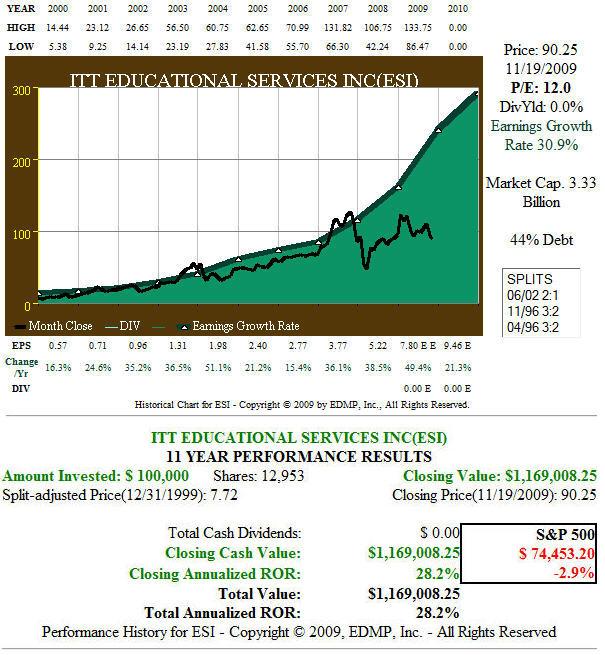
Figure 5 features ITT Educational Services, Inc. (ESI). Strong earnings right through the recession rewarded shareholders far in excess of the general stock market.

Figure 5 ESI: EPS Growth Correlated to Price and Price Performance

Figure 5 ESI: EPS Growth Correlated to Price and Price Performance

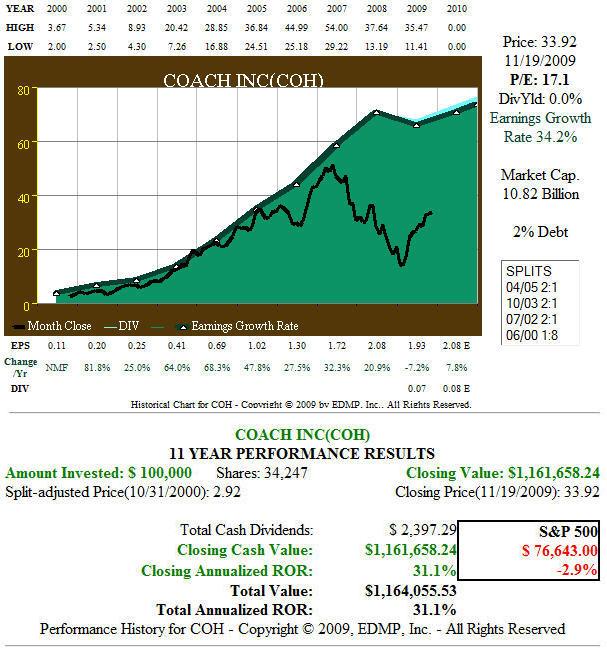
Figure 6 features Coach Inc. (COH) where 30% growth of earnings translates into a similar shareholder return, regardless of the bad market. Note that both Coach and the S&P 500 are measured only from October of 2000 because Coach was not a public company in 1999.

Figure 6 COH: EPS Growth Correlated to Price and Price Performance

Figure 6 COH: EPS Growth Correlated to Price and Price Performance

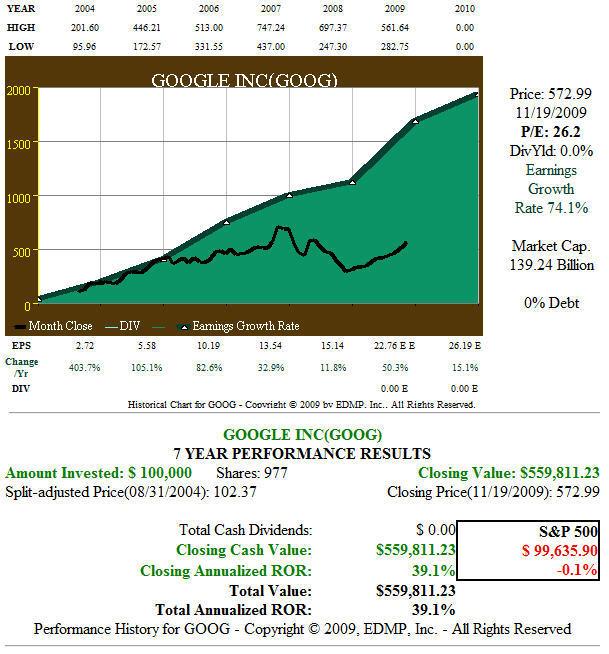
Figure 7 features Google, Inc. (GOOG) and only has a track record since going public in 2004. However, once again, there is no correlation or relationship to Google shareholder results and the stock market (S&P 500).

Figure 7 GOOG: EPS Growth Correlated to Price and Price Performance

Figure 7 GOOG: EPS Growth Correlated to Price and Price Performance

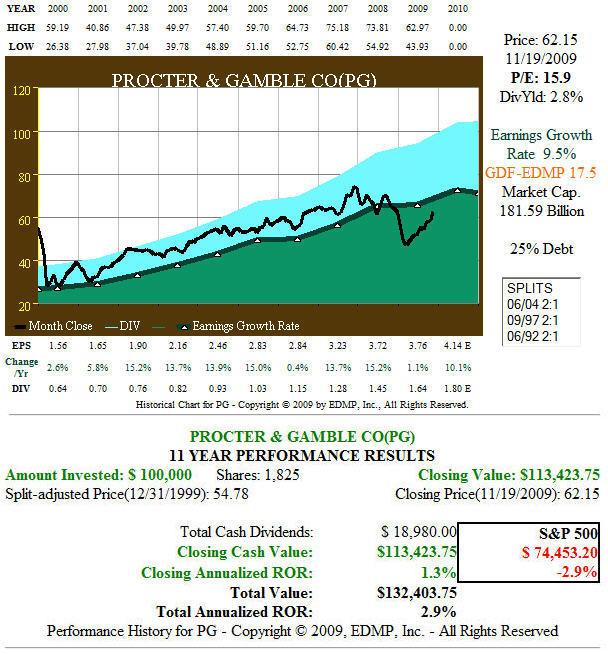
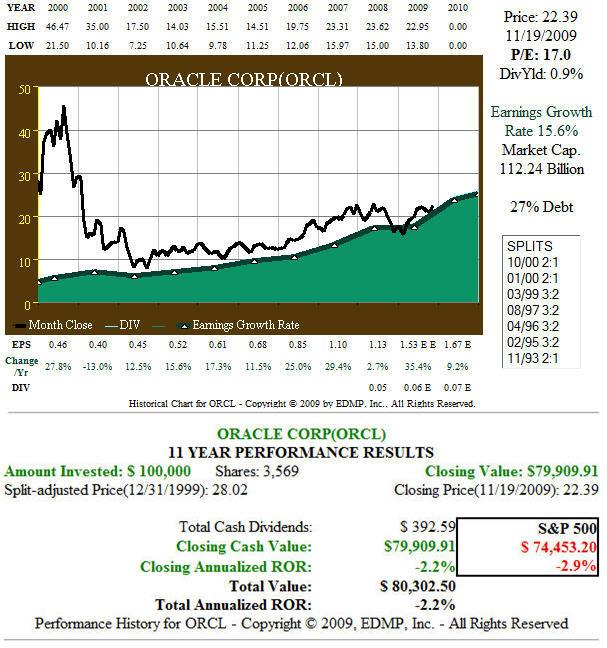
Figures 8 and 9 are offered to illustrate the importance of valuation. Both Procter & Gamble Co. (PG), a Peter Lynch stalwart, and Oracle (ORCL), a faster-growing technology company suffered from overvaluation at the beginning of the period. Both of these companies generated returns that were closer to the general stock market. However, it was overvaluation and not the market that affected their respective results.

Figure 8 PG: EPS Growth Correlated to Price and Price Performance

Figure 8 PG: EPS Growth Correlated to Price and Price Performance

Figure 9 ORCL: EPS Growth Correlated to Price and Price Performance

Figure 9 ORCL: EPS Growth Correlated to Price and Price Performance

These are but a few examples of many that could be offered. Remember the stock market is about averages, and as Warren Buffett also said "Who wants to be average?" It is better to focus on what you own and not worry about things you don't. I believe you will find this to be more peaceful and profitable, in the long run.

Conclusion

We, like Peter Lynch and Warren Buffett, believe that all the fuss about what the stock markets in general may or may not do is unwarranted, assuming - of course - that valuation is in line with cash flows. At the end of the day, we feel that all it does is take the investor's eye off the critical ball of what they actually are invested in. Wall Street may climb a wall of worry, but good businesses climb a wall of business success, more commonly known as earnings. Therefore, what the stock market may or may not do really shouldn’t matter to the serious long-term fundamental investor.

Sunday, November 22, 2009

Dan's retirement plan

As a way of introduction to explain the rationale for my trading methods, I
retired in September of 2000 and currently live from my investments, both
income and capital gains. Other than social security, I have no pension.
I invest and trade, with boundaries somewhat overlapping. The vehicles I use
are stocks, bonds, options, and futures. I do some day trading on rainy
days, otherwise I stay away from extremely short term trading and do no
Forex trading. I believe that trend following, as a means of market timing,
works, but that is not my subject for today.

I am writing today to comment about Value Investing.

There are companies with many years of consistent and growing earnings ,
little debt and in market segments that are expected to grow, but they are
not necessarily "Value" stocks. Why? Simply because the stock price is too
high in proportion to its current earnings and projected future growth.

As value investors we seek to buy stocks with consistent and growing
earnings in strong market segments, companies that have a reasonable debt to
equity ratio, but companies whose stock price does not reflect the potential
for these companies, in other words, undervalued value stocks.

The problem with this approach is that the inherent assumption made is that
the professionals in the market, for one reason or another, have overlooked
the quality of this company. Even assuming that the above is true, that
investment companies employing legions of research analysts have overlooked
this company that we have found, what is the trigger that will make market
participants realize what we have discovered, and equally important, how
long will it take for this to happen.

For my longer term investments, I eschew any company that does not pay
dividends, and dividends at a reasonable level. A dividend of 1% is
meaningless. I look for companies with many of the same characteristics as
used with value stocks, but with the proviso that the dividend stream is
secure, and expected to grow. Today, I will rarely consider anything with a
current yield of less than 6%. At the time of this writing I have found A
rated bonds yielding over 10%. The A rating implies a relatively low level
of risk while the high yield means they are out of favor. Therefore, any
stock purchases made today should be expected to return, between income and
capital gains, at least that much annualized using a reasonable time frame.

Unlike waiting for the market to appreciate the potential of a non dividend
paying value stock, by purchasing out of favor high dividend paying stocks
or high interest paying bonds, I am earning a fair rate of return on
invested funds as well as expecting a capital gain down the road.

Dan (dan2fl)