http://seekingalpha.com/article/173475-china-consequences-of-the-sleeping-lion-awakened?source=email
U.S. President Barack Obama has begun a nine-day tour of Asia at a time when the U.S. economy is struggling to emerge from a deep recession. But nothing looms bigger than China, the largest holder of U.S. debt (around $797.1 billion, up 10% this year), that has emerged from the global economic downturn in an ever stronger position. When Obama sets foot in China for the first time, he will confront a dramatically altered balance of power between the two nations.
Two Decades of Explosive Growth
This seismic shift is driven by China's astonishing economic growth over the past two decades and has accelerated during the global financial crisis. Its 9% to 10% annualized GDP growth rate in the past two and a half decades is unprecedented in world history.
In 1992, Chinese gross domestic product (GDP) was less than 7% of America's GDP. By 2000, the figure topped 12%. When Obama won the election in 2008, the Chinese economy had grown to equal more than 30% of U.S. output. New data show that China is on track to grow more than 8% in 2009, driven by high industrial output and retail sales.
Impressive Stimulus Package…and Working
During this global recession, China's astonishing growth did slow down, but unlike most developed economies, China never entered a recession.
The Chinese have launched the world's biggest investment program (about $585 Billion) after the start of the financial crisis last year. Beijing's stimulus program is estimated to amount to about 13% of Chinese gross domestic product, making it almost twice as large as the U.S. program and close to five times the size of its German equivalent.
The government's massive economic stimulus program has transformed the country into an enormous construction site. As a result, China’s industrial production rose 16.1% year-over-year in October, the most since March 2008 and a slide in exports eased to 13.8% the slowest pace this year. However, behind the impressive economic data, troubles might be lurking.
China Bubble Forming
China’s purchases of dollars to prevent appreciation gave it foreign-exchange reserves totaling $2.3 trillion in the third quarter, the world’s largest. Meanwhile, its sale of Yuan to keep it fixed to the dollar contributed to a 29% jump in its money supply, and the peg helped spur more than $150 billion in speculative funds from overseas in the past six months, according to China International Capital Corp.
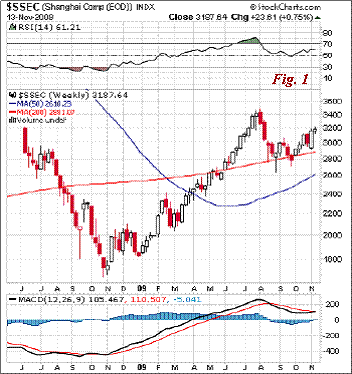
In addition to playing the stock market, a lot of the money is being diverted into houses and land. There are also reports of excess capacity created by the aggressive stimulus effort. Record apartment prices and a high flying stock index this year are prompting warnings against "financial risks" and the development of bubbles in real estate markets.
Yuan-Dollar Peg Angers Many
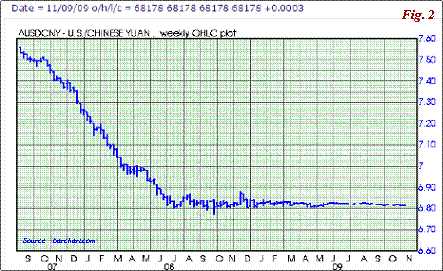
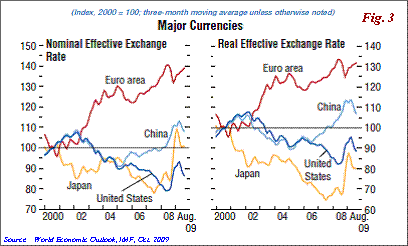
Beijing has kept the Yuan pegged at about 6.83 per dollar since July 2008, seeking to help manufacturers battered by the collapse in demand abroad. The Yuan advanced 21% in three years from July 2005. (Fig. 2 & 3, click to enlarge)
China Quashes Yuan Policy Speculation
Most expect that in Obama’s meetings at the Asia Pacific Economic Cooperation (APEC) summit and then in Beijing, China’s fixed-rate policy will likely be part of the discussion. On that note, investors are seeing a rising Yuan. Twelve-month non-deliverable forwards for the Yuan in Shanghai are signaling trader bets on a 3.5% gain from the spot rate of around 6.83.
However, in what seems to be an official effort by Chinese authorities to dismiss the renewed speculation of Yuan appreciation in the near term spurred by a recent language change from The People’s Bank of China, on Saturday, the state-controlled Chinese news agency Xinhua reportedly said that the government would not allow the currency to gain against the dollar in the short term. Goldman Sachs (GS) also just reiterated its three, six and 12-month forecasts for the Yuan to stay at 6.83 against the dollar.
Yuan to Appreciate…Eventually
China’s drive to create jobs and maintain social stability through export-led growth means politicians aren’t ready to loosen controls on the currency. In addition, China’s trade surplus will probably be half last year’s level at $200 billion, which means a bit less pressure on the Yuan to appreciate. The U.S. doesn’t want a stronger Yuan either because that would cause a collapse in the dollar in the short term.
Over time, China will likely be under pressure to open and let the Yuan appreciate in the next 24 months, and possibly as early as the 2nd half of 2010, albeit at a very gradual and modest pace, while most likely still pegged to the dollar. Eventually, the Yuan will appreciate considerably due to China’s high growth rate and its population’s high savings rate (35-50% range) .
On Nov 11, in Singapore, World Bank chief Zoellick calls the dollar's role as a reserve currency "relatively secure," but says over the next 10-15 years the Yuan (Renminbi) will provide an alternative once it is internationalized.
Strong Growth Prospect
China is a communist country with capitalist power. Despite China bears’ prediction of a Chinese size collapse, for a country with such a tremendous resource base and centralized system, busted bubbles in sectors most likely will not derail the country’s global leadership path started over two decades ago.
In a speech a few days ago at a conference organized by the Monetary Authority of Singapore, International Monetary Fund (IMF) Managing Director Dominique Strauss-Kahn called on Asia to play a leading role in guiding the global economy to a new, more sustainable path for global growth.
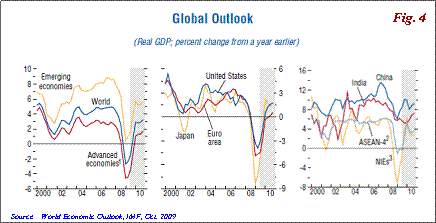
The IMF expects Asia’s GDP growth, driven mostly by Chindia, to be 5.75% next year—almost double the 3% rate forecast for the global economy. Specifically, the IMF projects China annual growth to be 8.5% and 9% for 2009 and 2010 respectively. In contrast, advanced economies annual growth in 2010 is projected to be about 1.25%, following a contraction of 3.5% in 2009. (Fig. 4, click to enlarge)
Chinese Exposure Desirable
China’s surging asset prices, a dollar collapse and a double-dip global recession are the biggest risks investors face in 2010. But many analysts are bullish on China for the long-term as 500 million educated and unemployed Chinese spur greater domestic spending and production.
Yet, Americans are estimated to have only 2% to 20% foreign stock exposure. That means Chinese stocks represent probably a low single-digit percentage, at most, in the average portfolio. With very few high investment return prospects, China is one market that should be given some serious consideration as part of a long portfolio.
There are many ways to play the Chinese market. The following are just a brief overview of some that I will discuss in this article.
B Shares
For investors interested in adding some Chinese exposure, B shares are a good bet for those who hold dollars and want to benefit from China’s fast economic recovery. The shares traded at an average discount of 49% to their A-share listings, according to BNP Paribas.
China's dollar-denominated B shares at the Shanghai Stock Exchange jumped 9.42% to 251.19 points last Friday, posting an 18-month high. The surge mainly resulted from market expectations of Yuan appreciation.
Though it is difficult to pick a good individual B shares stock right now as most are probably fully valued, it is best to avoid stocks of property developers as a way to minimize the risk of a potential real estate bubble. According to Morgan Stanley (MS), the sector’s share price has gained about 155% on average in the past year.
ETFs
An ETF is a convenient way to invest in China. But it could be a bumpy ride as a three-year measure of volatility for China ETFs is more than double that of the S&P 500.
The two most popular China ETFs are iShares FTSE/Xinhua China 25 Index (FXI) and SPDR S&P China (GXC). Both of these are very heavily weighted towards financials. On the other hand, PowerShares Golden Dragon Halter USX China (PGJ) has only about 6% exposure to financials, and has been around since 2004.
For currency plays, the WisdomTree Dreyfus Chinese Yuan (CYB) and Market Vectors Renminbi/USD ETN (CNY) are two ETFs specializing in the Yuan. But a recent WSJ article cautioned investors about the pitfalls of the Yuan ETF because it is in a contango market similar to that of the United States Natural Gas Fund (UNG).
Consumer and Commodity Blue Chips
Since B shares and China ETFs may have more risks and volatility than some might like, blue chip companies with an increasing presence in China could be a less risky way to ride the Red Dragon.
Chinese President Hu Jintao recently said that the government is focused on expanding domestic spending, “especially consumer demand” to strengthen the economy. This could present opportunities for consumer-related stocks. U.S. blue-chip companies such as Wal-Mart (WMT) and McDonald's (MCD) are likely to benefit from this trend.
Similarly, with China’s insatiable appetite for all natural resources, non-U.S.-based producers such as BHP Billiton (BHP), Rio Tinto (RTP), and Vale S.A. (VALE) could also provide good portfolio diversification.
Nevertheless, I would advise against commodity futures ETFs due to the intensifying regulatory scrutiny and the potential “rolling effect” commonly experienced in a contango market as discussed in my previous article.
Author's Disclosure: No Positions
Related Articles
- Dollar vs. Yuan: Exchange Rates Aren't the Problem. Or the Solution Nov 16, 2009
- China's Nine Nations Nov 16, 2009
- Applauding Shanda Interactive's Latest Strategic Move Nov 16, 2009
- ETF Update: China on the Rebound? Nov 16, 2009

No comments:
Post a Comment